Showing posts with label tidbits. Show all posts

Tuesday, February 10, 2015

Random Pieces: Toilets in the Rural Areas

It was the little things that signaled a sharp shift in reality for me when we first moved to Africa.  One of my first earliest memories on the continent is seared into my brain for just such a reason: I remember running out of our new house to get the gardener after he had just welcomed us and then  left to go home.  It couldn't wait until tomorrow: I had no idea how to use the toilet. As he probably did many times after, he thought I was crazy for sure.  

People talk all the time about the different pieces of culture, language, and nature they find in their travels, but sometimes just the little things related to infrastructure can remind a person they are in a new reality.  

Here stand a row of "toilets," as they are called.  If these toilets look like they are in the middle of a field, that's because they are.  They belong to a large rural school a kilometer away. What is a kilometer for a student to walk for the bathroom when they have already walked 15 kilometers to get to school?

Except for that Halloween my junior-high self somehow thought it would be a good idea to dress up like a Puffs Kleenex box, here is the most unattractive picture of me ever taken. But it's pretty much one of my only pictures of a Shona "chimbuzi" (toilet).  Set away a few dozen meters from the rest of the homestead buildings, the toilets at many Shona homesteads are separated by sex.  For men it's "varume," and for women, like above, it's labeled "vakadzi."  These bathrooms are literally a tin roof on top of a flat cement slab with a hole in it. Soap and water sit outside for hand washing.

Thursday, November 20, 2014

Africa, Uncolonized

It's been one of those months in which a lot of unexpected "what ifs" have popped into my life.  While I'm busy dealing with my own, here's a little "what if" I found fascinating...


Click here for this new perspective on African colonialism: Africa, Uncolonized: A Detailed Look at an Alternate Continent

Friday, October 10, 2014

Happy Harare

I've been meaning to post it for months, but my recent lack of time seems to make this the perfect moment to show you some tidbits of my African hometown.  With the recent healthcare challenges surrounding ebola outbreaks and the understandable but depressing reports of poverty crises defining most of the First World's focus on the continent, undoubtedly Africa could use some positive representation.  Congrats to my dusty city, dancing in their recent coming of the rains.  

Reuters may have so far deemed it the century's "least livable city in the world," but I'll answer that claim later.  For now I will truly cherish this video, complete with people we know and places we go.  A little taste of the Harare few outsiders get to see:  


https://www.youtube.com/watch?v=g1CNgQhf8bA

Wednesday, October 8, 2014

Fifteen Things


What a busy week!  I just read an article explaining how women let their blogs "go cold" alarmingly more often than men.  While to do lists and mulling over large ideas have got to be on the list of explanations I'd give if guilty, let's not let this blog get any colder.  While I am putting out fires on a different continent, here is a wonderful blog post I'd like to share with you.  If you haven't learned some of it from following Well It's Africa, hopefully this blatantly stated list will get you thinking, too...

Fifteen Things You Shouldn't Believe About Africa:


I love number eight.

Thursday, August 21, 2014

Ellie Dung

I've been doing some random thoughts on my post topics as of late, and here is another for you.

Elephant dung.

It is everywhere in any place even remotely, partially, tiptoeingly touched by the elephant species.  As an important part of the environmental cycles of Africa, the steaming pile of manure is an important way that these giant creatures contribute to their surroundings.  This is a nice way of saying that elephant dung is the ultimate African compost, churning tons of foliage mass into ground up hay every day.  In fact, most elephants produce over 100 pounds (over 50 kg) of dung per day!  But who knew it was important to humans, too?

I was sitting in the car in Western Zimbabwe one day waiting for my family to come back from a bathroom break.  We were literally in the middle of nowhere.  Not a human in sight for miles.  Then a car pulled up next to us.

It was strange, I first thought, that this car should park so close to us when there were, oh, 500 kilometers of space between us and the nearest parking space.  But the really strange thing turned out not to be the choice of parking, but rather why the car had parked.

A woman got out of the car with a plastic grocery bag.  She walked over to a fresh pile of elephant dung, and with her bare hands, she picked up as much dung as what would fit in the bag.  With no sheepishness at picking up a giant pile of feces, she set the bag in the trunk, returned to the car, and proceeded to drive away.

My mind was blown.  Seriously?  Had I just seen that?  Absolutely I had.  I had been the weird girl scrambling in the back seat, fumbling to get my camera to show my missing family what I had just witnessed...


When I asked a Ndebele wildlife scout later on that night outside of Hwange National Park about my strange encounter, he had nodded his head.  "Yes," he said. "Elephant dung is a very useful thing. It can be dried and burnt at night as a way of repelling bugs, or a lot of people use it ground up herbally for stomach ailments." He went on to explain that the smoke from burning ellie dung is believed to give people peaceful sleep and good dreams.

We may be living in the 21st Century, but how strangely awesome that there are still people out there that know some of the amazing uses for crazy pieces of nature.  Look up elephant dung online and you will find it is also a useful paper-producer, coffee filter, and garden fertilizer. 

And if nothing else, it makes one wicked snowball.

Monday, August 18, 2014

Piece of Cake


It sounds odd, yes.

And it’s a weird topic for a quick blogpost… but it’s the little things that are sometimes noticeable cultural differences. 

We eat our cake differently in the US.  I have no idea how much of the rest of the world eats cake like this, but in Africa a celebration cake or birthday cake is eaten out of the hand.  One will go to an absolutely posh party with linen napkins and every other decorative detail looked after, and then be served cake straight into his/her hand, gooey frosting and all.  In the US, it’s pretty safe to say that cake is never considered a finger food unless it comes in a cup-cake wrapper.  Funny little details.

I’ll take my cake with a fork, please!


Sunday, July 13, 2014

Orphanage Month: Random Pieces of the Orphanage System


-We classify the orphanages we know by two factors: 

One factor is the provision going to the children in the orphanage.  All orphanages here have great needs, but it is clear that the needs of some children are being met in some orphanages more than in other orphanages.

The other factor is the quality of care. Children at some orphanages are supervised and being raised under higher standards than others.

-Donations go out the back door in some orphanages, sold by the staff instead of being given to the children for which they were intended.  In some places it is hard to give unless we place the donation directly into the child’s hands or place it on the child’s body. 

-Children learn what behaviors get them results; thus some orphanages have the most unruly children that behave like animals whenever visitors arrive, in an attempt to receive as much as possible. The loudest gets the most. 

-Orphanages are often full of disease.  Imagine one hundred children sharing a bathroom with no toilet paper, toilet seats, soap, or towels.  Fungus, hair loss, malnutrition, colds and flus, athlete’s foot, and lice are all more than common.  Aside from the questionable behavior mentioned above (and "questionable" is a generous term here), disease issues always left me wondering if I was being a good parent by having my own little one at the orphanage.  Upon returning home after a visit, the first thing we always did was bathe.  Thoroughly. Everything in the wash.  The orphanage bag was relegated to the floor of the same closet, and was washed weekly.  Even in lovingly run places, an orphanage is a dirty space.

 
-Most orphanages have a couple of staff members exhaustively working for a hundred children, or have a large number of staff that never leave the break room.  Either way, the result is often anarchy: children raising children.

-We have seen children talking to or playing with the following in place of toys:  a door, a wooden bench, a brick, a metal rod, a seed, a shirt named Alice, a paint chip named Henry, and a tree called Isador.

-It is a tricky thing to decide which orphanage we should help more.  An orphanage of high quality care that provides loving guidance and good facilities to its orphans. Or an orphanage that provides terrible care for children and thus has needier children desperate for any drop of food or love.  Which would you choose?  We never quite decided, but found ourselves torn between the two.  Our methods of giving became very different, dependent upon what orphanage we were visiting.


Saturday, March 15, 2014

Pieces of Learning: Gender Tidbits


Some random facts about the workings of gender within our particular African culture:

-Traditional to Shona custom, a dowry is paid by the groom when a man marries a woman.  Unfortunately, this can make for very long and complicated wedding days. Guests stand outside the gates or property and wait while the groom bargains and negotiates with the future father-in-law. (Even when someone is engaged for months, negotiations happen the day-of.) Things can get awkward and tense if negotiations do not go well.  These negotiations can last for hours, so by the time the couple is actually married, guests are half-starved and huge celebrations are in order!

-Because a dowry is paid for a bride, there is a common attitude in Shona culture that the husband “owns” the wife, as he paid for her.  Therefore, the concept of rape or abuse within marriage is not understood; a man has the ability to treat his wife as he would like.  Abuse statistics in this country are shocking.


-If ever you want to see strong women, move to Africa.  In traditional Shona culture, the man walks in front of the woman with his arms free to protect her.  She, in turn, often carries everything.  Items on her head, in her arms -and almost always- a baby on her back.  Quite the amusing opposite of the well-intended chauvinism I often found when living in the Bronx- a place where every man offered to carry things for me, heavy or not!


-This is my personal estimate, but I would say about 90% of all Shona women in the country wear skirts. Though pants are acceptable and also accessible, the fashion preference is clear.

-Bikes are extremely popular among Shona as an attainable mode of transportation.  Used bikes go for approximately $400 a piece here, and new bikes are approximately $1,000.  The interesting thing is that although there are bikes everywhere, I have never yet seen even one ridden by a woman.  It is just not done.


-It is illegal to be gay in our country.

-It is very common to see two grown men holding hands while walking down the street.  Hand holding does not indicate romantic involvement in the same way it does in many Westernized countries.

-According to our Shona housekeeper, it is traditional that a Shona woman does not look her father-in-law in the eye or make conversation with him.  This is a sign of respect.

-Men eat separately from women and are served by women. It is considered by manners to leave your plate/dinner place before the older men have done so. 

-We have been blessed to celebrate a few baby's births during our time in Africa.  Shona men are traditionally not allowed at a birth.  Often the baby is born at the hospital or clinic, then the husband is called to come pick up the wife and baby immediately or one day after.  Non-gender side note:  The hospital does not provide food or water for inpatients; they must have people bring those things to them if they want to eat or drink while in the hospital.

-Traditionally, when a first-time Shona mother who has just given birth comes home, her mother stays with her for over a month.  No travel is allowed for a new mother for one month once she arrives home from giving birth.


Wednesday, February 19, 2014

Pieces of Learning: Products and Pushes

Some more random tidbits about the products and cultural trends I've found in southern Africa....

-It won't seem abnormal to a variety of people from other countries.  But to an American it is a bit weird.  There are no crutches on this continent.  In America, medics, nurses, and hospitals are equipped with crutches that lean on the ribs below the armpit.  Here, braces that fit around the forearm, like the ones pictured below, are standard. These are what are known as "crutches."


-Here a large percentage of students, even those who have expensive imported sneakers and sports-specific shoes, do gym class in bare feet.  No matter what the color or economic bracket, this is a very normal cultural push in Africa.


-Meet the most common pot scrubber in our country, plastic mesh fruit/veggie bag.  Here it is common for Shona to ball these up to make their own - a valuable commodity that only comes from grocery stores.  We never throw ours away; they always go to the staff.


-There is a large push in Africa for male circumcision.  You can find this push everywhere, on bumper stickers, tee-shirts, billboards, and other random places- like this car we came across in South Africa: "Over 93,000 free male circumcisions a year!"


-Plain products can often be hard to find.  Our first year here I think we found plain white toilet paper twice.  And plain white marshmallows?  Forget it.


 -Most of the masses in southern Africa use bar soap. Referred to often as "green soap," these bars are used for bathing, hair washing, laundry washing, and dish washing.  At over a foot long, and hard but oily, these potent bars are everywhere!


-It is hard to find plain honey.  Honey is marketed most often as a specialty of flavor, like wine... On the left is Msasa honey, made from the seasonal nectar of Msasa trees. It is known for its nutritional value and is a dark cooking honey. The honey on the right is a jacaranda honey.  Again, it is produced during a specific season in southern Africa, and is known for its sweetness. 


Sunday, November 10, 2013

Pieces of Learning: Southern Gonarezhou and the Low Veld


-The tribal people who used to live in Gonarezhou before it was taken over for national park land are called the Shangani.  Efforts have been made to get the land back to its previous caretakers.  Arguments against allowing the people back on the land are that tourism and space for wildlife needs to be promoted, as the droughts that occur five out of seven years make the last almost impossible to live upon.  Arguments for allowing people back on include the viewpoint that tribal people like the Shangani know how to live on the land because their ancestors have developed sustainable lifestyles there for thousands of years. The longer they are off the land, the sooner this cultural knowledge dies.


 -The land is currently extremely difficult for humans to access, requiring petrol and food to be carried for hundreds of kilometers into the wilderness. Large vehicles are required to fordge rivers and streams during the rainy season.  The debate continues: develop the park more to improve accessibility and, therefore, tourism dollars, or leave the park as pristine as possible?


-The village closest to our entrance to the park is called Chikombedzi.  Known for its poverty, the Shangani people that live there have little economy.  Much of the isolated village consists of living space for people under tarps and blankets.


-Poaching has been a long and uphill battle for the park.  Not all gates are manned, and the vast expanse of wilderness makes it very difficult to supervise.  Anti-poaching teams can be found throughout the park at all times, following herds and monitoring migration numbers.


-Though the park does not have one of Africa's most endangered animals, the rhino, it does have another.  Packs of painted dogs roam the land in small numbers. Counting efforts used to monitor these populations have dwindled over the last ten years, though the animals are occasionally found.


-The park at one time had prison locations within it.  This is because the land is so hard to survive upon that no one in their right mind would try to leave the walls in escape.


-Not one road goes all the way through Gonarezhou from the south to the north or from the east to the west.  This meant that if we wanted to see the famous Chilojo Cliffs on the other side of the park, we had to travel about eight hours out of the park before getting a road that would lead back in.  Examples like this mean the park is extremely hard to manage.


Saturday, July 6, 2013

Pieces of Learning


Heading for the wilderness of Manna Pools with friends Jon and Nisse next week has inspired me to think about the animal tidbits we've learned over our last eleven months on the African continent.  As we prepare for another respite in the bush lands, here are some things you may not know about African wildlife:

-A group of giraffes is called a tower.  Recent travel buddy Abbie was desperate to see a large one on our trip.  No worries; the family all came out to say goodbye just as we were leaving Hwange National Park.

-A group of standing zebras is called a herd or a zeal. A group of moving zebras is referred to as a dazzle.

-A group of vultures is called a wake, venue, committee, cast, meal, vortex, volt, or kettle.

-I was desperate to see one notoriously evasive animal while we were last on safari.  No luck.  The pangolin, so rare that our guide of 20 years experience, Ray, has only ever seen one in his lifetime, did not come out to play.  Do look up this crazy animal if you've never heard of it.  (This is obviously not my picture!)


-Rhinos are one of the most endangered animals in our country, due to loss of habitat and poaching.  To help the population, rhinos in almost all national parks are preemptively de-horned.  This prevents poachers from killing the whole animal for one piece.  Many a fashionable rhino, like these guys we saw in Lake Chivero National Park, is walking around without a horn.

-This is a "boma." (pronounced boe-mah)  This Swahili word refers to an enclosure often used for livestock.  The boma above, located in the Mukuvisi Woodlands, has netted sides that are put down when new wildlife are dropped in via helicopter or delivered by truck.  The boma is used for animals being newly introduced to the woodland, usually as part of conservation efforts.  The (usually drugged) animals need space to awaken safely before acclimating to their new environment.  It's an eyesore in an otherwise beautiful landscape, but serves an important function.

Monday, February 18, 2013

Random Pieces of Learning


I had a meaningful conversation just this morning with a local friend regarding the subject of excuses. Businesses here are obsessed with the excuse, almost to the point of loving having a reason to not get things done...

"Sorry. Couldn't answer your email.  The power was out."
"Sorry. Can't come today.  Flat tire from a pothole."
"Sorry.  We got tired of restocking shelves, so we're not selling anything that people buy too quickly."
"Sorry. We are closed today because we are not open." (Seriously-just saw that sign on the door of a pharmacy yesterday.)

Very normal.

So here is my excuse.  I was electrocuted this afternoon.

Very abnormal. 

But seriously.  I was electrocuted this afternoon.  (Picture Timmy on Jurassic Park, minus the blood coming out of his ears.) And while I sit here giving our security fence the stink-eye, grateful it wasn't our three-year old or my right arm, I am thinking I’d like to say that this excuses me from producing a quality blog today.  I have such a hard time writing this blog on a normal day, let alone ones in which high voltage has gone through my brain.

Don't get me wrong; I love writing this blog on most days.  But I find myself tiptoeing on Well It's Africa much of the time, which makes it difficult. I am constantly challenged to communicate our experiences without stepping over the line of what is allowable for me to say while we're at the whim of our host country.  And I still feel ignorant, which just won't do when I am attempting to be as accurate as possible without making generalizations.  I avoid the subjects I feel too ignorant to speak upon; but after posting even simple thoughts on Well It's Africa, I still go to bed nervous that I've said too much. I learn what Africa means every day in some new way, and recognize I am moving forward.  But it's slow. 

In the meantime, despite my list of excuses, please be entertained with silly fluffy things, like observations about big spiders and fascinating bird beaks, as well as some of the harder subjects I skim, but wish I could expand upon more, like the complexities of being an affluent white American girl in a culture that is… different.  

Here are some more random pieces of learning, while I recover from my "shocking" afternoon:

-Speaking of fences, metal and plastic objects are often used on fences around game parks and farms to keep wildlife from walking or stampeding into them. 

-B.Y.O.V. ... Never assume how anything is done here.  Two weeks ago I made an appointment at the doctor's office, where Kurt and I were to get the final dose of our Hep A vaccination, right on schedule.  Except that after sitting in the waiting room for a while, one important detail was clarified.  We were supposed to bring the vaccinations.  Doctor's offices do not keep vaccinations because of power outages.  You buy them at a pharmacy first, then take them to a doctor to inject. I missed that one.

 
-Pudding is a funny thing in Africa... When the hostess at a Christmas Eve party we attended went inside to "get the pudding," I was surprised to watch her return with brownies, cake, cookies, and well, more cake. (They love their cake in this country!)  "Pudding" is a term that can be used to describe any assortment of desserts.  Pictured above is what you get if you specifically order a dish of "pudding" in a restaurant... cake covered in a sweet sauce.  Jonas is having to re-adjust his definitions...

-You can get ice cream in Africa.  In fact, a local market here even sells Haagen-Dazs… only $17 for a small container. Other prices for luxuries: 
Small package of diapers- $25
Container of make-up foundation- $35
Small bottle of sunscreen- $30-$40
Container of contact solution- $30


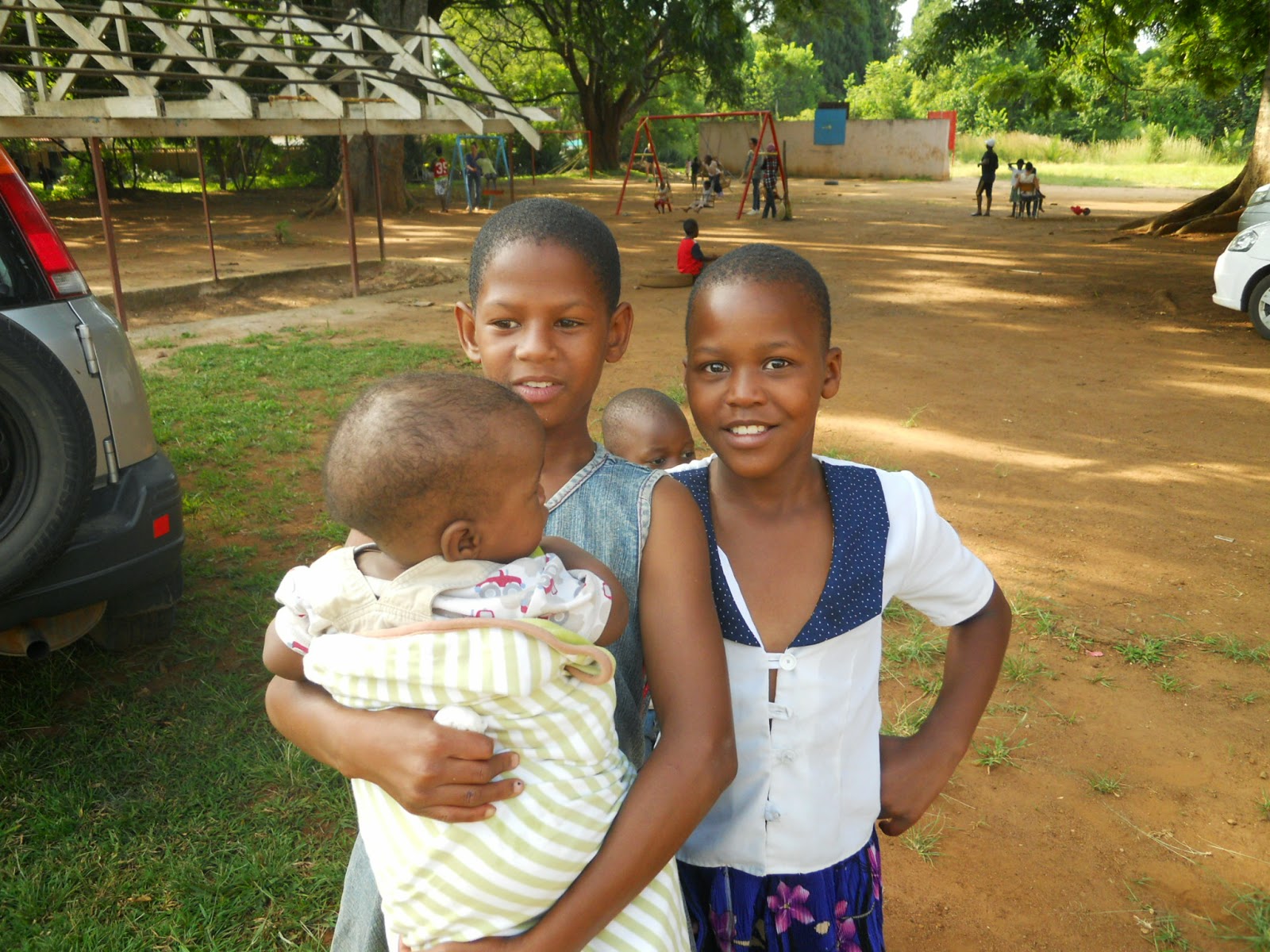
-Life does not stop for child-care. Here are how almost all Shona babies are carried in our country: wrapped in a bath towel, legs stretched around the back of their caregiver.  One can tell if a woman is slightly wealthier, because she will be wearing a towel that matches her clothes.  It does not matter if it is over 100 degrees; babies are bundled to their chins in these for hours a day, sleeping with their heads hung sideways, lulled by the motions of their carrier.  It is cute, but it results in many bow-legged Shona babies who get little time running around.