Showing posts with label culture. Show all posts

Friday, May 29, 2015

The Great Zim Childhood


I was amused by the above list, sent to me recently by a friend, of eleven memories you have if you grew up in Zim.  It's a great list and I'm sure it could have been fifty pages longer, but it's a good start... Wait, well... that is, if you could afford it...  What so many Zimbabweans able to access things like HIFA and Sam Levy's and this internet page so quickly forget is the fact that this broad blanketed "Zimbabwean childhood" actually only describes about five percent of the population, if that.

As I recently answered a classroom full of excitedly squirming kindergartners all raising their hands with questions about how people lived in Africa, it became very clear very fast that for every question there were two starkly different answers I could give. One involved what people with a lot of money lived like. Answers tended to describe people attempting to live as Westernized of lives as they could while "making do" with the challenges of living in Africa.  And one answer involved what the povertous did to survive life with almost nothing.

I just moved to a "First World" country in which people talk constantly about the stark contrast between the wealthy and the middle class and the poor.  Indeed, the differences do seem extreme... until we remember almost all of us still get to sleep on a bed at night. It puts our differences in stark contrast to those living in true poverty in other parts of the globe.  The list above is fun, but even better?  It reminds most of us about what we seem to forget so quickly... Wherever our childhoods, wow, we're lucky!


Monday, May 25, 2015

To Braii


Happy Africa Day!!  This day falls on America's Memorial Day, so I get the good luck of having two great reasons to celebrate!  And speaking of celebrating... experiencing some beautiful weather today as we celebrate has put me in the mood for one of the most popular southern African past times one can find... the braai.  In South Africa and Zim, the word braai is one of the most beloved words in existence.  As both a verb and a noun, braai refers to the act of grilling meat outside.  And boy, is it an act.

Learning to braai is a right of passage for the upper classes of southern Africa; when we had asked contacts in Zim about what to move with us to the continent the first piece of advice was to go out and buy the best grill possible.  Any get-together that does not involve tea seems to involve alcohol and braaing meat in a situation in which the words "lean" and "still hungry" have no meaning.

Many of the Shona we met were fascinated with this style of cooking raw meat over the fire's heat in the way that we do, either on a grate or in foil.  My housekeeper was fairly horrified -even when it was just in the oven or on the stovetop- as one of the first rules of cooking in her village was to never eat meat that was not boiled first.  I am sure this was a lesson that proved very important for sanitary purposes, but was difficult to get out of her entrenched view despite our refrigeration and washing methods.  We had a number of Harare Shona ask us to teach them how to cook meat over a fire, and I have to be honest- we were surprised! Though fires are used all the time for a variety of foods, including meat, the formal act of braaing was seen by many of the economically challenged Zimbabweans we met  (not trying to overgeneralize here- I'm sure some people don't fall into this category) as being something fancy that was done by upper classes.  Huh, who knew!

Many of the meats used in southern African braais come already seasoned and spiced from the local butcher.  That can be hard to replicate from other parts of the world.  But other meats, like sirloin steaks, come undressed and begging for a little tropical taste.  Here is one of my favorite braai recipes, excellent for plain steaks or chicken breasts alike. It combines the tropical heat of a spicy rub with some sweet pineapple juice perfect for tenderizing.  In celebration of the holiday, I invite you to bring a little Zimbabwe to your plate!

It takes a little ahead-of-time preparation, but it is well worth it...

Cheri's Tropical Heat Meat, Zim Style

4 plain chicken breasts or steaks

1 1/2 cups pineapple juice

1/8 cup brown sugar (Don't want refined sugar?? Try 1/8 cup maple syrup instead!)

1 1/2 tablespoons cayenne pepper (Don't like spice?? Replace this with 2 tablespoons of paprika!)
1 teaspoon oregano
Salt & pepper
(I'd say "to taste," but you don't want to taste at this step! I use 1/2 tsp salt and 1/4 tsp pepper.)

1 tablespoon garlic powder

1. Stab the meat with a fork and drizzle half of the juice over it; let it sit for twenty minutes. Flip the meat over and drizzle the other half of the juice on the second side; allow it to sit for twenty minutes also.  This adds sweetness, but also tenderizes the meat.


2. Throw away any extra juice run-off.  Mix all of the remaining ingredients in a bowl and then put into a plastic zip bag with the meat. Make sure to squish the meat around in the bag, getting all sides covered with the rub.  Allow this to sit in the bag in the refrigerator for 1-3 hours... Or even overnight if you like!  


3. Cook the meat over the a grill the same way you would grill any other meat.  Make sure to cook the meat properly and thoroughly.  There may be some juice left in the bag after the meat has been removed. You can baste or pour this on the meat during the last half of cooking to add some extra flavor.  Enjoy!!


Thursday, May 21, 2015

Ndebele Dolls


Though the smaller Ndebele population is often overshadowed by the larger Shona population when it comes to Zimbabwe, the Ndebele people's presence stretches far into the countries of South Africa, Zim, and Botswana.  I recently had the amazing joy of sharing a few pieces of my Zimbabwean Shona and Ndebele experience with a local kindergarten learning about Africa. I had no problem filling all the time I could get with pictures and stories. But the teacher had requested I bring in a few craft ideas for my time, as well... and suddenly I was stumped.

The arts and crafts presence of the Shona Zimbabwean tends toward beaded necklaces made from drilled seeds, carved wooden objects, imported fabric sales, and soapstone and metal sculptures... not extremely colorful, and not exactly what I should be doing with the average kindergartner!  Then I remembered Ndebele Dolls: These unique dolls are colorful and unique treasures just like their makers, the Northern and Southern Ndebele people.


While dating, it is traditional for a Ndebele suitor to place a doll outside of a young woman's home to indicate his intention to marry her.  The young woman names and cares for a Ndebele doll while preparing to marry, then names her firstborn after the doll.  These dolls are now found exported all over the world, and serve as a huge source of income for some Ndebele people. 

My Ndebele doll is one of my favorite colorful finds from my time in Africa.  You can see why!

Tuesday, February 24, 2015

Running on Rumors


It was with a sense of horror that my sister emailed me recently, "What the heck?!!! Is this for real???"

Below her questions she had pasted a link leading to a Zimbabwe Today headline about Disneyland Vic Falls. I, too, was horrified and clicked to read an article about the future of Victoria Falls that included a great deal of commercial venue/mall space/Disneyland-like theme areas.  But here's the thing: In Zim you cannot, cannot, believe everything you read.  Without the same responsibilities of free speech and truth-telling journalism as many other countries enjoy (and I do realize the irony of this, as my lil' ol USA is actually pretty horrible about this, too) Zimbabwean papers are notorious for creating tabloid splashes out of their headlines, dramatizing coverage, and printing the most bizarre stories first.  Imagine that what you see in the tabloids of your First World check-out counter is the only news you have available.


 A friend of mine recently posted a Zim-written article on Facebook.  Like nails on a chalkboard, I read the headline and saw the source.  It didn't matter if the underlying argument was true or not; it was a gross moment to read it and observe the lack of sources, recognize the lack of research, and count the large number of errors in just one little piece of writing.  It was as though I had just gone to correct a high school student's attempt at a news article.  I wanted so deeply to explain to her that when she treated this piece like a legitimate news source, it just encourages and supports a gross way of "informing people."

Still, where do people get their news?  What do you do in a society in which it is easy to question every single piece of information dangling on the wind??

News is a complicated thing in a place run by word of mouth.  In a country in which official press releases are few and assumption and rumor run the gamut, fear and chaos often tell the story.  What is not in the papers is often whispered behind walls and doors, and often evolves into different conversations according to the race of people doing the whispering.  The rumor mill of Zim is a full-time business.  It feeds fear and makes it an undercurrent in every business and home.

The rumor mill used to drive me crazy; my first weeks in Zim were spent in horror as the small circles I came to know revealed their gossip craze.  It was hard to handle and harder to discern fact from fiction until I realized that this is what happens in a society that is never fed the truth.  Like ever. And suspects that everyone, from the government, to the other race of locals, is out to get them. And please note, this is different than in many other countries in which we have research, studies, factual evidence, demographics charts, tables, and statistics.  This is a place in which a stat is considered true if someone bothered to make it up.  Many other countries are challenged in their inaccurate reporting and press issues, but in this situation I am referring to a place that has little statistically to back up any conjecture.

And yet we come back to the question: HOW do people living in a place like Zim get legitimate news? Without analytical research to back up a number of claims made on the situation of the country, its politics, and economy, narrative takes the place of number.  People's individual experiences become much more important to current conversation.  As American anchor Brian Williams could recently tell you, the challenge as individual narrative becomes relevant is how to control stories from turning into snowballing rumor or over-exaggeration for the sake of convincing others.  That I don't have an answer to!  

One of the reasons my blog is fluffy at times is that I refuse to write about something I don't know enough about. I have sooo much to say about politics and culture and the fascinating details of how anthropologically these things play out in a racially segregated system.  But I can't imagine crossing the line into conjecturing what I don't know.

The horrifying thing to me always is that thousands of people, educated enough to read but not quite savy enough to discern or fully identify inflammatory sensationalism (sometimes I fall into this category, too!), read newspapers without a background knowledge of understanding that sometimes the press does not present things in the most transparent way. It's a beast of a subject, whether in a democratic First World nation or in a tiny political entity run by dictatorship.  In all senses, truth is a tricky thing whether we put it in the hands of giant syndicates or our neighbor's neighbor's ear. But tying it to a fear so deeply rooted that it sleeps under everyone's bed/mat? Well, welcome to Zimbabwe!

PS: I get asked about articles often; for the sake of this blog post I just picked the most innocent news topic possible as an example.  If you're curious, here was the article my sister asked about, followed by a piece of my response to her: http://zimbabwe-today.com/2015/01/business/american-investor-to-invest-460m-for-disneyland-vic-falls/


"I do think it's a matter of time before they ruin Vic Falls.  That said, I hugely doubt it would be an actual Disney thing.  I wonder of that guy was just throwing the term around as an example or if he was serious, because the rest of the article never said anything about talks with Disney or anything related to it.  But YES, they are going to build up the falls. 

I think the complication to come -and soon- and what makes me so so so thankful to not be in Zim right now that all signs are pointing to the return of the Zim dollar.  The government is starting to reprint coins and from there, it will only be a matter of months before Zim dollars will be the forced currency... and then everything is down the drain again. People are very skeptical of its success, and it could put the economy to a halt again.  So we'll have to see.  I have no doubt Vic Falls WILL eventually be heavily altered by investors, but most of these giant projects have huge patterns of stalling and delays (there were two projects sort of like this in Harare that are still ongoing). 

The other factor is that Zim has laws about ownership having to be at least 51 percent black Zimbabwean, so it complicates things greatly.  Large companies like KFC have tried to come in in the past and have failed because there is too much "white ownership" to be legally operating in Zim.  So I am doubtful Disney would ever be there under those race based rules.  But other investors?  Yes, if they fit the qualifications... unfortunately these race policies never seem to be in place when China wants to buy things, it seems on the surface anyway pretty much just white Zimbabwean/European/American owners that get pushed away with these policies.  But I could be wrong, as I don't know all the facts- just the whisperings of the locals on this one.  My guess would be that a Chinese company will be heavily involved rather than an American one in Vic Falls investments... But in South Africa?  I could definitely see a Disney happening there eventually....

 This website (I'm familiar with it) never has a lot of facts going with its stories.  It's a rumor based paper, as so many are in Zim.  And there are truths to be found, but a lot of it is not total accuracy...  Just pat yourself on the back you have already seen the Falls when it was a little less spoiled!!"


Tuesday, February 10, 2015

Random Pieces: Toilets in the Rural Areas

It was the little things that signaled a sharp shift in reality for me when we first moved to Africa.  One of my first earliest memories on the continent is seared into my brain for just such a reason: I remember running out of our new house to get the gardener after he had just welcomed us and then  left to go home.  It couldn't wait until tomorrow: I had no idea how to use the toilet. As he probably did many times after, he thought I was crazy for sure.  

People talk all the time about the different pieces of culture, language, and nature they find in their travels, but sometimes just the little things related to infrastructure can remind a person they are in a new reality.  

Here stand a row of "toilets," as they are called.  If these toilets look like they are in the middle of a field, that's because they are.  They belong to a large rural school a kilometer away. What is a kilometer for a student to walk for the bathroom when they have already walked 15 kilometers to get to school?

Except for that Halloween my junior-high self somehow thought it would be a good idea to dress up like a Puffs Kleenex box, here is the most unattractive picture of me ever taken. But it's pretty much one of my only pictures of a Shona "chimbuzi" (toilet).  Set away a few dozen meters from the rest of the homestead buildings, the toilets at many Shona homesteads are separated by sex.  For men it's "varume," and for women, like above, it's labeled "vakadzi."  These bathrooms are literally a tin roof on top of a flat cement slab with a hole in it. Soap and water sit outside for hand washing.

Tuesday, November 25, 2014

I Wish I Had Time to Tell You

A very smart person I know once told me that one of people’s biggest problems was that they didn’t do math properly; it’s impossible to keep adding things to one’s life without taking something else away.  As I look at my slivers of free time, torn between wanting to spend every second with my child and husband, just getting in a little more sleep, investing in future projects, and the two hundred other things on my list, it has become apparent.  Maybe it should have been apparent when I had a housekeeper and a gardener and still wasn’t always finding time to brush my teeth before noon.  Maybe it should have been apparent when I had no job and still couldn’t find the time in my calendar to go to the doctor when I needed it.  Maybe it should have been apparent when I had a kid in school for half days and still couldn’t manage to do that exercise regimen I always told myself I’d adopt if only I had a few hours to myself each day.

I never have enough time. And it’s because I have been terrible at doing my math.

Almost every white local I knew in Zim made their opinions of my family clear often; I really should be having more “white babies” if I could at all help it.  What a terrible shame that my son had no siblings.  In a land of large families, something was terribly wrong with my family according to Zim standards.  My response was always a long and complicated one, but needless to say, it always involved wanting to be able to provide my best for my existing child, who I didn’t know how to care for with the same level of competent care if I carried on with more children. 

“Oh, that’s simple,” I was responded to during the last time I discussed the matter in Zim. “You don’t take anything away from the first. Your love, your patience, etc, stay the same. It’s just time that you lose.  You just have to share your time more.  Easy.”  As if time was not already one of the most valuable, rare things in my life. 

It was, however, an easy thing for a Zimbabwean to say. This Zimbabwean’s math was influenced by the fact that she sent her children away to boarding school at five. Oh, and also she had never had any of her five children without also having three housekeepers on hand to help with nannying.  Sharing my time more, it is clear now that from my Spanish surroundings I have work, a child at home full time, and no staff, is tougher than ever before.  It’s no longer possible to share any more of my time without losing the quality of my ability to be a mother.  Or a human being. 

Time is a more precious commodity than I can express.  But lately I haven’t been acting like it.  And though I’ve said and thought over and over about how much I value it, the truth is that recently I’ve been adding a lot and taking away nothing… except quality.  And presence.  And energy.  It’s time to start doing my math again.

I should clarify that I am desperate to keep this blog.  It’s one of my last connections to Zim.  And I still have oodles to say.  And thousands of pictures to show.  I still serves its purpose in sharing the continent with those who have not experienced it themselves.  And it allows a number of Africans to commiserate on what they love or miss or want to change about their homeland.  It’s been wildly more successful than I ever imagined and now I feel a certain amount of obligation to keep it going.

But I need to start doing my math.

Here is what I wish I still had time to write about: the malaria thing, the recent farm take-overs in the Save Conservancy, Clean Water vs Harare’s City water, the never ending bloom of Zimbabwean cassia trees, the spread of the magical acacia tree canopy, and the craziness that is the giant millipede called the chongololo. 

I wish I had time to discuss with you the complexities of a Zimbabwean white minority that is more economically powerful than the black majority but has no political power, a fascinating anthropological study in the making. 

I wish I had time to discuss our experiences with the 2014 elections, the burning orange flowers of the flame tree, all the different uses of thatching, the craziness of police stops where window-smashing often occurs, the rules of the road around the pres. mansion, the fragility of the Zimbabwean electrical grid, the how-tos of surviving being passed by the pres. motorcade, the rows of toilets that line the countryside next to rural schools, the oodles of hospitable places we’ve stayed, how gardeners and laymen often grow and paint one long fingernail to be used as a tool, and the giant rat (it’s a real thing, which we actually had in our yard- look it up!). 


I wish I had time to tell you about “The Big Five” and “The Little Five,” the miniature size of parking spaces and how there are only a handful of car brands that make it into the country, what the Harare Airport is like and how it used to be before Zimbabwe made itself into a political pariah, what The Great Dyke is, and how children’s names and ages are often changed in orphanages to make paper-work easier.

I want you to know about Chiboku (the homemade street beer that often includes fermenting the likes of pieced apart animals, weeds, and car batteries, and is said to age a person five times faster than regular beer). 

I want to tell you about the Rhodesian Ridgeback, the out of control rumor mill that runs the country when the papers do not report truths, the loveliness that is The Farmhouse in Chimanimani, the endangered wild dogs of Zim, the awkward transition of renaming things back to Shona after having colonial names for a hundred years, the Shona totem (an inherited personal symbolic animal indicating familial lineage), the endangered rhino, a crazy assortment of encountered bugs, the taste of an African cucumber, and the future of a people who cannot seem to let go of the past. 

If you want to know more about Zimbabwe beyond this blog, these are great but tiny places to start.

Stay tuned for one more, last post on some of the things I have learned from Mother Africa.  And in the meantime, know that I am grateful to those of you who followed our journey through these last few years as we awkwardly but enthusiastically embraced this amazing continent we will always consider a piece of home.  It's been humbling to have readers follow our thoughts and adventures, and it is truly with sadness that we finish before the story feels entirely told.  The late and great Maya Angelou once said, "There is no greater agony than bearing an untold story inside you." Have us over for a cup of Rooibos sometime; we'll tell you anything more you want to know.

sunset photos by friend Lucy Fisher

For questions, comments, that cup of tea, or better yet a personal tour around southern Africa, contact us at: cherijohnsondesign@gmail.com

Sunday, September 28, 2014

If International Travels Have Taught Me One Thing...

it's that everybody wants TV.


Harare's most infamous slums: overpopulated, cardboard walls and beds, no windows, no plumbing.  But plenty of TV.


Monday, September 15, 2014

Afterthoughts: The Dirty Little Word

It's a lot to process, this unseen transition that takes place when one suddenly finds oneself waking up in a "First World" country once again.  Blogging in my African garden months ago, I thought I would have a post or two about my time leaving.  But something now tells me that the learning and wisdom that comes from rewiring oneself onto a new continent may just expand in a slow rising for the rest of a lifetime...
- - - - - - - - - - - - - - - - 

There is a dirty little word the ex-pat community in Zim whispers quietly, never speaking too loudly, lest it be misunderstood.  

Listen closely, because I'm nervous to say it out loud.  

DeAfricanization.  

This word could mean a hundred things to a hundred people, and many of the definitions could have an understandably negative connotation for sure.  But I want to let you in on this secret little word, whispered by anyone preparing to leave the home they have come to know on a shiny, hair-pulling, beauty queen, beast of a continent called Africa.

DeAfricanization. Whether you like the term or not, it's being used by expats everywhere, as the concept that there is a transition one goes through when leaving the continent.  It's more than just a needing to become desensitized to the sudden sensory overload of signs and ads and billboards and media barraging from every angle after stepping off a plane.  It's more like an involuntary, personal, mental-quarantine of sorts, that takes place while a person comes to terms with the Third World problems that suddenly no longer exist at the front of conscious thought when one steps into a First World country.

It's understood that the longer one's been away from the First World, the longer it takes to make the transition.  But it's also understood that the more Africa has gotten in your blood, the more it pops itself up. At random times. In random places. When you least expect it.  With brighter colors and without the smell of urine or the feeling of cracked heels.  Maybe a bit romanticized.

 I'd be lying if I said I don't still have Africa tapping me on the shoulder a number of times each day.  But here is one example in particular that I had just a week and a half off the continent, when I came to see exactly what it meant to realize that the technological world had not stopped its "progress" while I had been a way for a few years.

Among other things, my sister's middle name could be One-Who-Does-Not-Get-Embarrassed.  So I knew my behavior was not the best when my sister, standing next to me at the public library in her town, looked around with a blush on her face as I angrily spoke to a man behind the counter.  But I just couldn't believe it.  I had just spent weeks worrying about what would happen to my staff.  How I would leave my friends unemployed in a country with an unemployment rate in the 90s and the third lowest GDP in the world.  I knew the value of employing people, of giving a human being work to provide for his/her self and family.  Africa taught me that.  And I was not going to forget it.  Then I walked up to the counter to check out my books, and realized that some people already had forgotten.

In place of a smiling librarian, ready to scan my books, I instead came face to face with what has become the bane of my existence at every American grocery store: the self-checkout. A machine that never fails to slow me down tenfold after raising my blood pressure tenfold.  I looked at it for a moment. Then I got in line at the old-fashioned circulation desk, waiting my turn rather than taking a decade to convince the computer I really was trying to scan a bar-code.  When the librarian ushered me forward, I handed him my pile of books.  He promptly pointed me to the self checkout.

"Can I not check out here?"  I'd asked defensively.

"Why?  Is there a problem?"

"I'd rather use a human than a machine," I said handing him my first book.

"No, we don't do check-outs anymore.  You'll have to use the machine."

"Really?  Your computer's not capable?  Can't you just scan my stuff, since I'm already here?"

"No.  Is there a problem with the machine?"

"No..."  I stared at him.

"Is there a reason you cannot use that machine?"

"I just like employing people... I'm giving you work." He looked at me like I was crazy.  Could this man not see that his very job was at stake when he was letting the computer do his previous work?!  Didn't he know that I was just trying to employ people? Were computers taking over the world? Oh, why wasn't I in Africa where this would never be a problem?!?   I was lucky to have One-Who-Does-Not-Get-Embarrassed with me, or I know I would have ridiculously made a scene that had little to do with the man and everything to do with the changes I found myself unready to witness.  I was being ridiculous, but how could I have just come from a place where people were dying to have a job to one in which people were happy to hand over their work?  Didn't anyone else see?!?

Over the next few weeks I came to see that technology hadn't just changed at the library. There were iPads swiping people's credit cards at the farmer's market. We got our restaurant bill on a tablet right at the table before signing and leaving without ever touching a receipt.  I walked through a food court at the mall and realized that this vendor does not take orders any more; you simply walk around the corner and pick up your food:

And suddenly, telling someone to hold the pickles on a hamburger takes
 twelve extra minutes as one navigates how,
exactly to ask a single question or make a single comment on an "easy order."

Even my four year old had noticed the technological differences in the US.  Our check-out woman had laughed at us one day as she looked down at Jonas. "It's as if he's never seen a check-out belt before!"  Not that he could remember.  And suddenly I realized.  Jonas' excitement at seeing fire trucks. And traffic lights. His amazement at seeing deer.  His pointing out of every neon sign we passed. His love of bulk-bins at the grocery store.  Jonas was going through his own silly version of deAfricanization, too.

I recognize everything would have changed had I been in Africa or America or anywhere else in the world.  But the difference was stark and the shift in reality was real. I was glad to have a term, the little secret word, to put a name to what I was going through.  And for the hundredth time in a week I had to decide whether to just smile or to explain that we had just returned from two years in Africa.

Thursday, August 21, 2014

Ellie Dung

I've been doing some random thoughts on my post topics as of late, and here is another for you.

Elephant dung.

It is everywhere in any place even remotely, partially, tiptoeingly touched by the elephant species.  As an important part of the environmental cycles of Africa, the steaming pile of manure is an important way that these giant creatures contribute to their surroundings.  This is a nice way of saying that elephant dung is the ultimate African compost, churning tons of foliage mass into ground up hay every day.  In fact, most elephants produce over 100 pounds (over 50 kg) of dung per day!  But who knew it was important to humans, too?

I was sitting in the car in Western Zimbabwe one day waiting for my family to come back from a bathroom break.  We were literally in the middle of nowhere.  Not a human in sight for miles.  Then a car pulled up next to us.

It was strange, I first thought, that this car should park so close to us when there were, oh, 500 kilometers of space between us and the nearest parking space.  But the really strange thing turned out not to be the choice of parking, but rather why the car had parked.

A woman got out of the car with a plastic grocery bag.  She walked over to a fresh pile of elephant dung, and with her bare hands, she picked up as much dung as what would fit in the bag.  With no sheepishness at picking up a giant pile of feces, she set the bag in the trunk, returned to the car, and proceeded to drive away.

My mind was blown.  Seriously?  Had I just seen that?  Absolutely I had.  I had been the weird girl scrambling in the back seat, fumbling to get my camera to show my missing family what I had just witnessed...


When I asked a Ndebele wildlife scout later on that night outside of Hwange National Park about my strange encounter, he had nodded his head.  "Yes," he said. "Elephant dung is a very useful thing. It can be dried and burnt at night as a way of repelling bugs, or a lot of people use it ground up herbally for stomach ailments." He went on to explain that the smoke from burning ellie dung is believed to give people peaceful sleep and good dreams.

We may be living in the 21st Century, but how strangely awesome that there are still people out there that know some of the amazing uses for crazy pieces of nature.  Look up elephant dung online and you will find it is also a useful paper-producer, coffee filter, and garden fertilizer. 

And if nothing else, it makes one wicked snowball.

Monday, August 18, 2014

Piece of Cake


It sounds odd, yes.

And it’s a weird topic for a quick blogpost… but it’s the little things that are sometimes noticeable cultural differences. 

We eat our cake differently in the US.  I have no idea how much of the rest of the world eats cake like this, but in Africa a celebration cake or birthday cake is eaten out of the hand.  One will go to an absolutely posh party with linen napkins and every other decorative detail looked after, and then be served cake straight into his/her hand, gooey frosting and all.  In the US, it’s pretty safe to say that cake is never considered a finger food unless it comes in a cup-cake wrapper.  Funny little details.

I’ll take my cake with a fork, please!


Wednesday, August 13, 2014

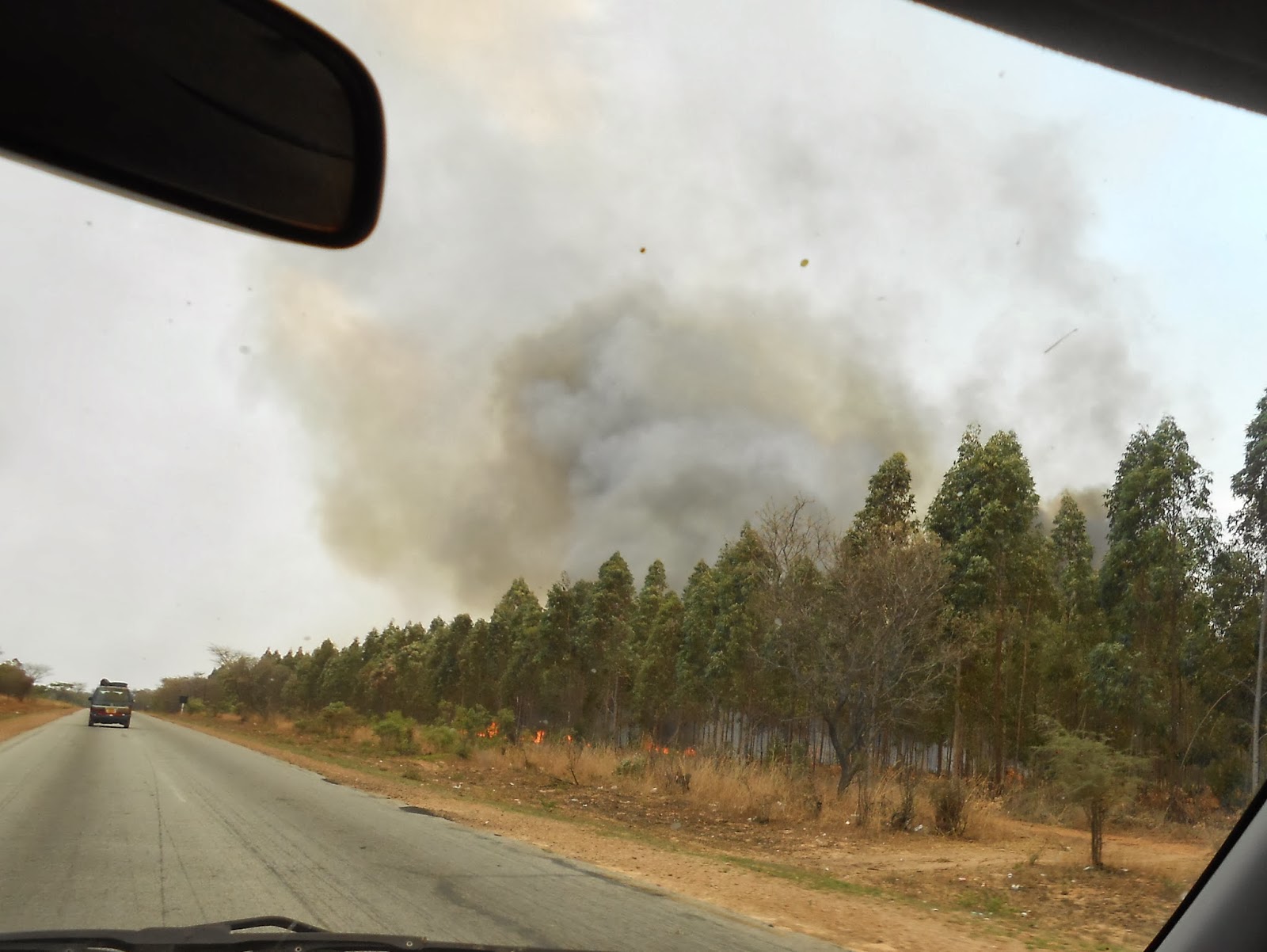
Burning Days


As we are busy settling into Spain after a marvelous, too-short summer in the US, I am none-the-less thinking of Zimbabwe constantly.  Though there's a lot I miss, here is one thing I don't... Late July and August means burning, burning, burning and smoke, smoke, smoke.  As fields get cleared for new crops, the end of winter and early spring means Zim is full of farmers setting fire to the brush that has not received rain in six months.  I don't miss this, Zim!


Wednesday, August 6, 2014

The Popular President

I heard it was Obama's birthday this week.  It reminds me, this guy has no idea how popular he is in Africa.  He is everywhere in Zimbabwe as a symbol of pride, and enthusiasm for democracy.  Most often he can be seen on imported American shirts and US election paraphernalia, but something about the flare on this shirt Jonas and I came across one afternoon tells me the fabric may be authentically from Africa...

Thursday, July 10, 2014

Orphanage Month: Redefining Definitions


My list of learning among the orphans of Zim goes on and on, but at the heart of it all lies deeply-rooted differences in the American understanding of orphans verses the African understanding of the same.  These are important to share as we process what “neediness” and “family” looks like in different pieces of the world.

We will admit it. We were taken aback when we came to realize that some of our definitions for words like “orphan” or “mother” or “husband” seemingly meant nothing in our new country.  We had moved to a complicated new land with blurred concepts of familial definitions and it was irritating. And messy. “Her mother is sick?  But I thought she was an orphan…” 

In Shona culture, relationships are often referred to as "family by choice."  They are not nuclear and put little emphasis on blood.  This can be irritating because a person can have twelve uncles or five mothers.  And every time a mother is sick, an employee gets time off... It's hard when we enter as Americans trying to actually understand who is related to who.  But in the end, our need for a definition on who's related doesn't matter.   Family by choice is such a strong bond here, that if two people claim each other as family, they take on responsibility for one another with a bond that is beautifully un-separable.

And in the case of an orphan, this is often a good thing.  It often keeps orphans out of an already unmanageably large institutional system.  But it gives those in the system little hope of being adopted, as most capable people in Zim already support large extended families and do not consider taking on other children.
The concept of orphan in Africa is different than in the US.  In the US it typically means that a child does not have a parent or guardian to provide care.  In Zimbabwe an orphan can be a child without a living relative.  But it is often also a child who does not have a parent or guardian willing or able to provide care.  Many orphans have family members that pick them up on holidays and special occasions, then drop them back into the orphanage afterward as a cost saving measure. 

I’ve often asked myself, “What is worse?”

To be a child optionally dumped back into the system after a holiday?
To be a child with living relatives that choose not to pick them up?
To be a child with living relatives that cannot afford to pick them up? 
To have no relatives at all?

We came to appreciate the blurry lines that define a true orphan in Zimbabwe. Because of blurred linguistic definitions, orphaned children fall under an umbrella of receiving help more easily than in the American system of technicalities and definitions that often decide whether a child should be adoptable or fostered.  (Please do not get me wrong, I absolutely still think the no-orphanage system many first world countries have adopted that forgoes the institution in place of foster is often the lesser of two evils… But that is a different conversation for another day!)

A Double Orphan is a term in Zim used to describe a child who has two dead parents. A Single Orphan is a term in Zim used to describe a child with one dead parent, and one living parent that is not involved.  In a single orphan situation, often the living parent is a mother.  In the Shona culture, if the mother remarries (often with the intention of providing for her children), the new father has the right to deny and refuse all of the children from the woman’s previous marriage at any point that he likes.  When this happens, the children from the first marriage are thrown out of the household to fend for themselves. Though they technically have a living parent, children in this situation are entirely orphans.


An orphan we recently worked with named Maxwell is an interesting example of this: Maxwell’s father passed away when he was a toddler.  His mother remarried a man who said he would keep her children.  He later changed his mind, and dismissed all the children from the household.  Maxwell’s mother did the unthinkable; she left the husband to be with her children. This is extremely rare in the Shona culture.  They all lived in poverty, homeless, since. Already Maxwell is expected to eventually provide for his two mothers and three younger brothers. Below, orphan Maxwell introduces us to his two mothers:

Friday, July 4, 2014

The Famous Buses of Zim

I always seem to think about posting bus pictures when I am preparing to travel myself.  As we undertake another new adventure, here are a few more for the collection:

"Laptop"

 
 "Kim" and "Warikandwa Tours"

 "Triple Fire"

 
"Relax Baby Boy" and "Special One"

"Cage Match"

 
"Mambo" and "Blessings"

"It Is the Lord's Duty"

"We Lead, They Follow"

"Go Well" 

"Mother's Love" and "Resurrection Power"

And here are some I missed over the past month, but would have loved to get a picture of:

Wagon of Love
Irreversible Adventure
Unserviceable
No Answer
Three Course Meal
Elshadai
Stars
Mine Rescue
More Research!
Out of Order