Showing posts with label staff. Show all posts

Sunday, June 15, 2014

The Housekeeper Thing, Take Two: Why I’ve Changed My Mind

Sleepless nights. Stomach aches.  Teary eyes.  I was fighting tooth and nail last week.  But it wasn’t for myself. 

It started when we heard from the wonderful people that will be living in our house after us.  A few excellent email exchanges later I knew they would love our yard as much as I do.  The problem was, I wasn’t so sure they’d love our staff as much as I do.  Coming from the same place I found my own self two years ago, they had good questions and concerns and just weren’t so sure that the housekeeper/gardener thing was for them. My heart broke as I realized our housekeeper and gardener may not only be out of jobs due to our departure, but even worse, would lose their home.

Suddenly I found myself thinking deeply about this concept of “staff” (housekeeper / gardener / driver / ironer / nanny) once again, this thing that sounds so bourgeoisie that I have tortured myself for two years over my participation in it. As I tried to rationalize the conflict of having staff with the value of doing things one’s self, I suddenly realized. I have entirely changed my stance on having staff. Two years of Zimbabwe has completely altered my concept of this important piece of the African economy we call “staff.” I recognize its value deeper than appeasing someone’s laziness or serving someone’s aristocratic values. 

As I rationalized staff to the newcomers emailing questions and concerns, I suddenly found myself emotionally writing a cathartic ten page love letter about our staff.  I typed faster than ever before, pouring out my experiences and opinions in a jumble of typos and sentimental notions and logical explanations.   So here it is.  My change of heart.  My explanation (a little more succinctly and with hopefully a few less typos) to anyone who asks why it is so very important to get over the foreign baggage and discomforts of the concept of staff in order to truly embrace and experience the culture that is now Zimbabwe:

-Being “served” by someone is a gift. An uncomfortable gift if you let it be uncomfortable.  And an amazing gift if you let it be amazing. It is all about attitude and how you respect others, whether the person you are dealing with is your boss or your employee.  It’s true.  When we first arrived here I referred to the Zimbabwean form of “having staff” as closely looking like bigoted households from the 1950’s American South.  I have seen some horrifying attitudes and have witnessed some atrocious words.  But we cannot group mistreatment in with every person who has staff; it is entirely dependent on the household.  Racial differences can be complex –or simple, depending on how you look at them- but either way, they can add layers of richness when a person is treated with love in an employer-employee relationship that becomes strangely intimate as your lives grow together.

-Having a job is honorable. Period.  An important notion I did not recognize until recently was that our staff do not find being of service to someone else at all embarrassing, dishonorable, or below them. Therefore, my discomfort has to end there. Gardeners and housekeepers who have come from the rural areas to make it in the cities as “staff” are incredibly well respected by their families and communities.  They are often the biggest bread-winners of the family, able to support many who have stayed behind, and eventually able to return to their rural areas to build homes for their retirement. If staff see themselves as respected professionals, I should get over my guilt of putting someone in a service oriented role.  Just because it is often work I’d rather not do, does not mean I am using someone or valuing them less.  I am employing someone. 

-Having staff is not about laziness. This city’s landscape was organized and set up by British people with British concepts of homes, gardens and yards.  To upkeep that concept on a continent like Africa takes a lot of time.  Africa is work.  More work than having an equal-sized home in the US.
-Plants can grow inches a day during the rainy season.  Or require watering every day during the dry season.  Electric fences must be kept clear and lawns mowed more than once a week during the rains. 
-A layer of red dust settles inside every window and door during the dry season.  Mud splatters every surface during the rainy season.
-There are poisonous spiders and many bugs.  If homes are not swept or dusted and furniture not moved regularly, they inevitably have infestation problems.  In Africa a person must be okay with having animals in their home. We occasionally have a bird in the house, we often have skinks and geckos on the walls, and there are spiders called “flatties” and giant striped-legged rain spiders that show up during the rainy season.  Most animals are harmless.  But if we do not sweep and dust things often, we start to be taken over by these things.
-All laundry needs to be heat-treated because of the pootsi and tsi tsi fly eggs.
-Having a fire in the home every night is common during the winter in these non-insulated concrete homes… but someone must chop the wood-often.
-A home owner should always have someone on the property when they go away, especially for longer than a few days. This is to deal with alarms, storms, maintenance, etc, but also to have a presence on the property. Abandoned properties do not last long here; even the plants can be stolen.
-I can go on and on.  The point is that this is not a place in which vegetation and yard work takes a break for even a day.  Mother Africa’s wild side is always pushing on the pieces that have been built/planted by humans.  Even if I took on our household and garden as my only fulltime job, I could still not do everything that would need to be done daily.

-Employing one makes a difference to many.  This country has the third lowest GDP in the world.* Unemployment is one of the highest in the world.  I mean poor, poor.  For every staff member one employs, another ten mouths at least are fed.  Our staff alone supports another 10-12 people.  Unemployment is so high that the culture of having staff is one of the only stable employments keeping many people fed across the country.  For every job a privileged person can offer to another, whether it is low paying or not, the effects trickle far down into the economy and the lifeblood of the nation as a whole.

-Having staff is like building a bridge. A very difficult bridge that will never quite be built until guilt/jealousy is set aside and it becomes a beautiful picture of two families helping to provide for one another in a symbiotic dance. It becomes a way of introducing both sides to a new culture.  Zimbabwe is full of wall after wall.  It can be hard to meet people and isolating to feel like the privileged person driving from those wall-to-walls. Our staff have opened a door for me to come to love people different than myself, to more deeply recognize the value and inner-workings of another culture, and to therefore learn more about this great country.

I could wallow in my guilt. (I am great at that- can you tell?!) Afterall, I did that for the first year we were here.  But slowly I came to realize that just because I cannot offer someone a house and living as equally large as the one someone gave me does not mean that it is not a gift worth giving anyway.  I have evolved away from my guilt toward something much more life-giving and meaningful than brooding away, pondering what I am not able to provide for someone I appreciate.

“The Housekeeper Thing,” as I called it, is so incredibly complex for a foreigner to move into.  It’s not just about having an employee.  It’s about sharing your yard.  Your home.  Your privacy.  And it confronts your privilege daily.  But as I look back on my time in Africa, it may just have been one of the most rewarding and biggest learning opportunities out of everything I’ve experienced here. 

In the end, our outcome is great.  I am happy to say my heart has changed and whatever difficulties of awkwardness and guilt I arrived on the continent with have now greatly subsided, opening me to deeper possibilities of friendship with those I now value so much.  And even greater, I am breathing huge sighs of relief to find out that we have convinced the new people coming into our home to take on our soon-to-be-ex staff.  Oh, what love and lessons we have learned from them, these wonderful friends:


Tuesday, May 20, 2014

The Bargaining Thing...


I was disgusted.  

Our third day in Zimbabwe, we sat with new colleagues, all American, and gabbed about our backgrounds and prior travels. As the conversation strangely turned to a few loud men discussing their bargaining techniques, I became less than impressed.  These over-confident men bragged about their skills lowering the dollars and cents they paid to people living farther below the poverty line than they could ever get coming from a country like America. I felt like I was listening to a conversation of Wall Street CEOs figuring out how to scrape even more cream off the top.  What difference did an extra dollar or two make to them, while a dollar could buy that vendor’s entire family dinner?

People back home ask me all the time how we shop and how we deal with "the bargaining thing." It's a hard question to answer, and I have certainly evolved.  At first I approached the markets differently than many of our new, well cultured, colleagues.  Though Kurt and I were scraping by with student loan debt and an unexpected mortgage payment that followed us to Africa at the last second, concepts no market vendor could possibly understand, I just decided that I would either pay what the vendor asked, or move on. No hemming and hawing, no sly negotiation, no insulting their products.  Just a yes or no. It seemed decent. And I was happy.  And it worked.  The problem was, I usually never bought anything.

After I’d been in Zim long enough, it became clear.  As my housekeeper and a number of others have explained to me, there is a Shona price.  There is a white person price.  And if you open your mouth to let them hear your accent, there is an American price.  “Americans are the most guilty, so that is why this works on them,” my housekeeper Ziwone had laughed.  Racial complications aside, she went on to explain that it was insulting to someone when I did not bargain, but just asked a price, said “okay,” and walked away.  “No one will accept a price that will make them go broke.  Bargaining is in our culture. It is more rude to ask and walk away than to try to negotiate.” Meanwhile, I watched as I came home with tomatoes twice the price of my neighbor’s, and one head of cabbage when the housekeeper would have gotten two. And forget about souvenirs.

Two years later things are different.  I’ve lived in a bargaining culture that has slowly worn me down and subconsciously evolved my thinking while I have been busy looking at chotchkies and curios.  I now have a method, which usually involves asking for the price of two other things before I find out the price of what I really want.  I know what things cost from the source, and what the mark-up is.  And I know how to unapologetically ignore the pushy vendor that will not get out of my face. Somehow when I wasn’t watching, I went from being the “guilty” American to being a savy shopper proud of saving a dollar here or there.  I patted myself on the back for being thrifty while living on one income… And suddenly I realized it was quite the same way I had done while living in the US.

I’ll admit it.  When I lived in the States, I would occasionally drive to Walmart or a different grocery store across town, all to save a dollar.  Though I always preferred to support smaller businesses and local (often more high-quality) products, there were times my wallet spoke louder than my ideals.  I was happy to find a bargain.  And it was how I made ends meet.

But recently our visiting guest, Kyle, unintentionally reminded me about something very important that I had nearly entirely forgotten after living in an African bargaining culture for two years. I watched as Kyle, absolutely uninterested in buying a product, chatted with vendors about their process and goods.  I watched as he kindly negotiated, and I remembered what it was like to be a soft skinned American wanting to remember my privilege. And I remembered once again that a dollar does make a huge difference to someone who has very few. 

The bargaining thing is more personal; I have to say no to someone’s face instead of to a numb Mega-Mart shelf.  There is inherently more guilt associated.  But there is also more humanity.  The Mega-Mart shelf is eternally more comfortable; there is a price and you take it or leave it. But what we forget when we shop like that is that there is still a little man or woman making the item. He/she’s just a few more steps removed, so the potential guilt at knowing someone is being paid pennies for their hour of work is farther away from our conscious thought.  The Mega-Mart shelf may be an easier option, but as Kyle so wonderfully reminded me, there is also something very powerful about the human interactions and learning that come from the process of bargaining face to face.

I’ll be honest.  As with so many things, when it comes to the bargaining thing I am still uncomfortably dancing around to find my footing on a happy medium.  It is easy to become desensitized when you find yourself in a different geography and, over time, evolve for better and worse away from your original values.  Wanting to represent your family’s budget smartly in contrast with wanting to give a small local vendor their fair share can feel challenging… But the more I think about it, the challenge exists anywhere I live…  whether in America or Africa.  


Monday, March 24, 2014

Fierce Finishes to the Rainy Season

African skies always love to pretend that nothing happened.  When we awoke Friday morning, birds chirped and a bright blue diadem with puffy white clouds shined overhead. One would never guess that the night before we went through a storm I can only liken to my experience living through 2011's Hurricane Irene.  Though this storm was rather quick, the clean-up will be anything but.  Six days later, the sounds of chainsaws buzzing through the neighborhood are still going strong and our electrical wires still hang in mangled messes throughout the neighborhood.  Sigh.  We are told it could be a few weeks before our power and internet are restored.  In the meantime, I will apparently be spending a lot of time at Kurt's generator-powered school.

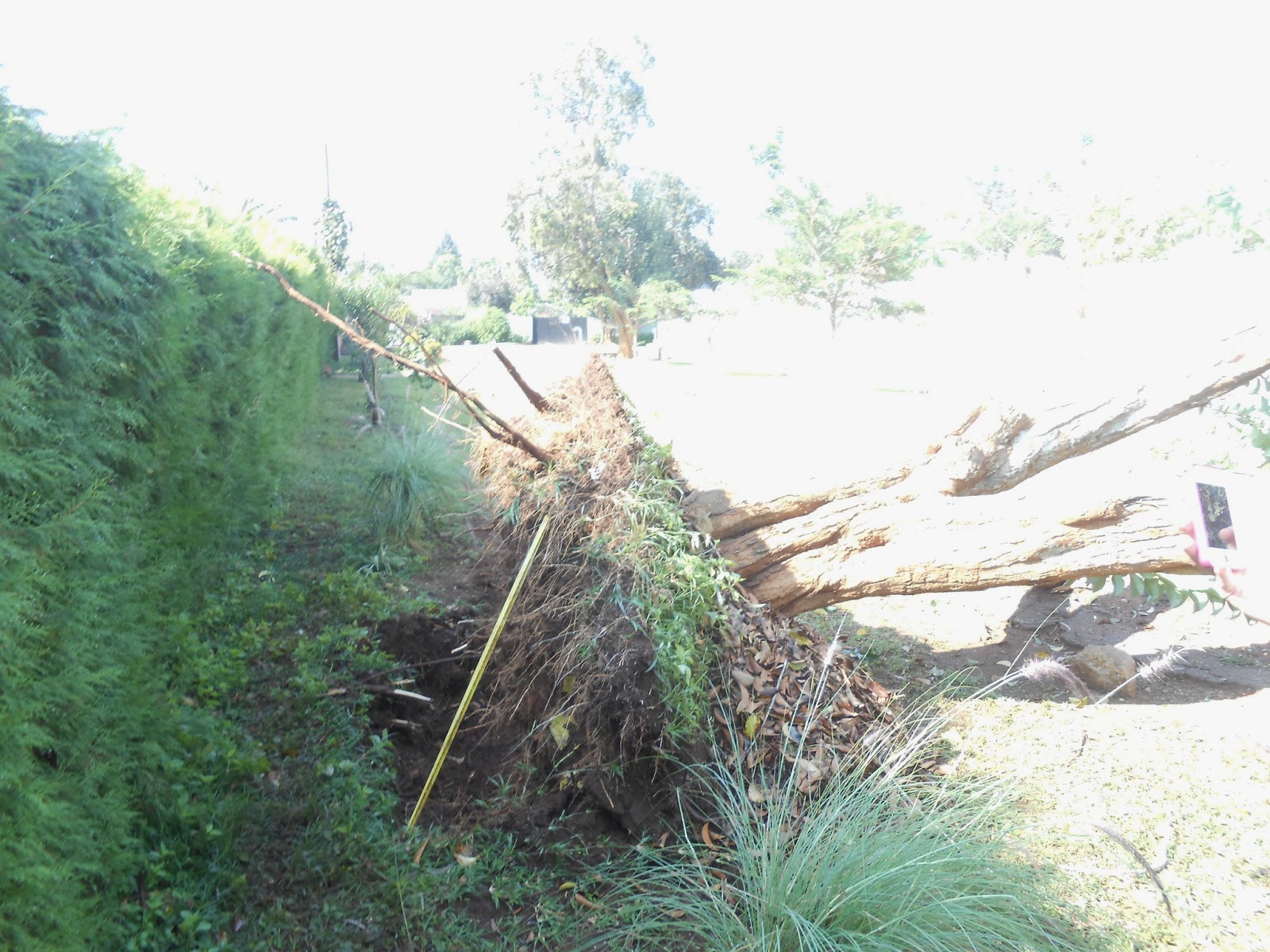
Our neighborhood received the brunt of the storm, with downed trees blocking roads on nearly every block.  WHAT a mess; we spent the day searching out petrol and groceries before watching a chainsawer spend eight hours massacre-ing 15 of our trees.  Meanwhile, most people were just thankful that no one anywhere seemed to have been hurt.  As we celebrate close calls and a plethora of firewood literally fallen from the sky, here are some pics of our/ our neighborhood's new challenges:

 Here is one of three sections of roof we are now searching for.  
Anyone seen the top of our chimney?


 Despite anti-burning laws in the city, from the looks of our (not even close to finished) twelve foot high pile, my guess is the neighborhood may be smokey for quite a while.


 I found it surprising to find oodles of tall pine trees upon moving to Africa.  The problem with them here is that their roots and the soil make for a deadly combination.  These toppling giants are hazards found all throughout our neighborhoods.

 We were unable to get out of our close (culd-a-sac) because of a downed tree.  After learning that the neighbor whose tree it was could not pay for the removal, us (albeit trapped) neighbors all pitched together to get the bill taken care of.

 Gotta find humor in the fact that the underground internet cable (above, yellow) just connected last week was pulled up by the only tree that fell on the close.  

 
Making new roads to get to the petrol station...

 
 Meet our (newly redone) power lines. (Surrounded by tall wobbly pines!)


 Four days after this tree is still on the road… and my power lines.

 
(Above, right) here bamboo poles are used to get ropes high enough on our tree to pull it away from the power lines before the cutting starts.

 
 (Above, right) Watching trees being taken down may be one of the saddest things I've ever seen.  Sigh.  We loved that tree... Fourteen more to go.

Friday, November 29, 2013

If Ever You Need Perspective, Two

Last year during Thanksgiving I posted a blog entitled, “If Ever You Need Perspective.”  The post quickly took on a life of its own. It has come back to me oodles of times through friends and associates that have received it from people I do not know. It has been re-posted and hit so often that I have followed it up, one year later, with a post on the same subject: 

If ever you need to feel humbled, move to Africa.  It was the day we finally got our car. Finally.  After a year of walking, renting, borrowing, and hitching.  Nothing was as sweet as finally -finally- getting a car to navigate a spread-out city full of thousands of struggling pedestrians and no sidewalks.  I was still walking on air and wondering how I would ever manage driving on the left when I walked into the kitchen.  Our housekeeper, Ziwone, stopped me with a pan of burnt oil used the night before for attempted French fries.  I looked in the pot, full of bits of old burnt fry, and said, “That’s trash.  You can compost it.” Ziwone, serious Ziwone who has never dared ask outright for anything, looked at me and moved toward the compost bucket with hesitation.  “It is terribly burnt…” I trailed off.  Silence.  “I could use this oil if you cannot,” she blurted out suddenly.  Her voice surprised both of us. I gladly told Ziwone she could keep the oil, and then walked toward the living room. My mind returned to our new car.  Out of the corner of my eye I suddenly saw Ziwone do a giddy jump before hurrying outside, pot in hand.  As I looked out the window Ziwone hurried to her gardening husband in the back yard with a huge smile, speaking fast Shona and gesturing like one of those women in shock over winning the lottery. Ziwone had changed from stoic, tired mother to starry-eyed child. I set my new keys on the counter.  And as I am reminded at least once a day in Africa, I was brought back to a place of humbleness and gratitude.  The pot of used oil, not the car, won on that particular day.


If ever you need to feel joy for the simple things, move to Africa.  After switching our car battery, a dead one sat on the cement next to our house for weeks before I caught the gardener looking at it one morning. When we later offered it to Shoman, I expected him to sell it for parts, or to a mechanic who could put it to some sort of recycled use.  As he happily carried it off he told me over his shoulder, “This will power my whole village with a radio!  I would be the hero of the people!”

Though joys like this swim across my eyes every day, none have been as good as the day I walked into the house and asked the housekeeper if her two children could go with Jonas and me to his school’s playground. Serious Ziwone got wide eyed and practically ran out the door, saying, “Just five minutes!  I have to get ready!” I laughed because I had meant the children, but the suggestion had apparently turned Ziwone into a child, too.  I could not tell who was more excited.  Jonas and I tossed a ball and waited. Ten minutes later Ziwone and her boys returned to our house wearing their best clothes. Jonas’ school has unique, “real” playground equipment. No sharp metal. No 1950s designs.  Pure, imported, US-designed plastic and wood Big Toys.  You have never witnessed joy until you have seen a child experience his first playground ever.   No words.   I took the boys back four more times that week, always dressed in their best.


If ever you need to be reminded of your fears, move to Africa.  A few weeks ago, I watched as our gardener’s three year old, Lilly, sank slowly to the bottom of the deep end of our pool. It was fitting, as Lilly‘s nickname, Libo, translates from Shona to mean, “caution!”  I dove in, clothes on, to retrieve the wide-eyed child from his close call.  We remained silent as I carried him to our house, my brain stuck in an acute awareness of the danger that feels multiplied in a place without good health care or emergency response. In the last six months we have tensely hunkered down for an election, stared down wild elephants, dealt with startling security alarms, floated down one of the world’s most dangerous rivers, possibly rid ourselves of an immense black-widow infestation on our porch and in our child’s bedroom, and cleaned up after the terrors of typhoid went through our household.  I have fought issues of fear my whole life.  But never have they followed me, confronted me, and shaken me as they have in Africa.


If ever you need to feel brave, move to Africa.   Though I do not hunt for my food, have only seen my computer-less doctor look up something in a thirty-some year old text book once, and rarely spend my afternoons wrestling lions, we are brave for moving to Africa.  Unfortunately this has little to do with the intimidations of moving to an unknown land and more to do with our daily situations.  I commiserated with a local friend of mine recently who, like me a month ago, had a gun pointed at her head during a tense moment in an intersection.  She was shaken, but her husband had comforted her later with a laugh.  “Don’t worry about it.  They probably didn’t even have enough money to put bullets in the gun!” Perhaps it’s the calm that comes from logic and factoring probability. Perhaps it’s a delusional comfort.  Or perhaps it’s intense naivety.  But always, usually closely after the what-ifs have all been discussed at length, there is a replay and a laughing off of the situation later, ending in a sigh about Africa. Overcoming our fears amid the rumors whispered daily among locals and forging ahead becomes daily ritual. Indeed, in the last six months we have tensely hunkered down for that election thing, had staring matches with wild elephants, heard the shrill sounds of our security alarms, spent time on one of the world’s most dangerous rivers, dealt with lil' ol' deadly spiders, and learned the nitty gritty details of typhoid epidemics. And we have conquered them all.  I have been told over and over, if you can survive the first year in Africa, you are African for life.  I hope so.


If ever you need to feel conflicted, move to Africa.  There is a well known story here in Zim.  You can tell how long a person has lived here by how they deal with finding a fly in their drink.  Newly arrived foreigners will see the fly and refuse to drink any further.  After a while in Zim, one will take the fly out and then drink the beverage. But the tell tale sign that someone has lived in Zim for a long time? The person sees the fly, shrugs his/her shoulders and drinks the beverage fly and all.  By these standards, I still fall under the classification as “new foreigner.” So how could I possibly be ready to leave?

We had a heart breaking decision to make on Wednesday.  So heartbreaking, in fact, that we waited until the very last second before it had to be made.  We may as well have tossed a coin.  Because how is it possible to say no to giraffes? How can one argue with tropical weather in January? And the awe of the grasslands?  And that word I have never before used so often…. “lifestyle”?  But our 50-50 draw fell on the other side.  We have decided to leave Africa at the end of the school year in June.  And pieces of us- the little ones left after being so torn for so long –may never believe that we actually made the choice.


If ever you need to feel certain, move to Africa.  It’s true.  We have no idea what is ahead, so we are absolutely leading with a leap of faith as we choose not to renew our contract with the school for further time.  I could talk about safety and health and a number of other factors.  But to delve into even one reason would require a hundred more.  Sometimes things come down to a logical list.  And sometimes, like our choice to leave such a beloved continent in seven speeding months, things can’t really be reasoned but instead come down to feeling the next step on the path with eyes closed.  After two years, we are certain.  It is time to leave Africa.

Until we go, we will breathe in our last days on this continent as we have up until now. With sighs. With wonder.  And with the fullest of hearts.  And then the day will come, and we will go.  Will we ever regret living here, challenges and beauty and dangers and blessings and all?

Never.  Look at how much we’ve learned.


PS, For those of you wondering from my first perspective blog-post, the man from the gate- named Peter- has returned once a week ever since…

Friday, October 4, 2013

Typhoid Trials

As I sat by our housekeepers’ hospital bed last weekend, watching her writhing in pain as tears rolled from her swollen eyes, my head spun.  I’d like to present myself as the brave hero that was nothing but confident that everything would be fine, but that would be entirely untrue.  Thoughts of handling a Shona funeral, Ziwone’s baby, and what I’d tell her husband crept into my mind.  And hospital bills…

I had refused to do it.  I just could not drop her off at P.N., the federally run hospital downtown used by gardeners and housekeepers all over the city.  The hospital is notorious for its day-long waiting lines full of corpses and all body fluids. When I thought about our gardener’s  uncle, who died in that very waiting line just a few short months ago, I turned the car and took Ziwone to a private hospital. It was more expensive for sure, but she was in bed hooked up to an I.V. within ten minutes.  And thank goodness she was.  It was typhoid.

Our first contact with typhoid fever has led to an exhausting week of medical tests for everyone on our property, clinics and hospital visits, and water samples.  Our high-elevation city of Harare has an amazing track record when it comes to malaria. But it is known for its outbreaks of typhoid, a serious, life-threatening disease still present in the Third World. The city’s water supply is often compromised with the bacteria, causing epidemic rampages among lower socio-economic citizens who use the water supply as their only available source of water.

Boreholes (sort of like private wells) on properties throughout the city are sworn to be safe.  But occasionally septic seepage can infect a borehole or, in some cases, an entire neighborhood.  When a person tests positive for typhoid, the city sends an investigator to test the water, as it is serious business.  Though we did have an investigator come quickly, he took samples from our hot water geyser when we had no electricity to run our borehole pump.  Therefore the accuracy of his test is anything but reliable, so we await a private company’s results.

Typhoid can be spread a number of ways.  Though it is a salmonella bacteria most often transported in water, it can be found on fresh produce washed with infected water, communicable through bodily fluids, and occasionally carried by an insect that has recently landed on infected feces.  It is a good reminder, if nothing else, to keep our guard up despite our comfort in the Third World. 

While we await our water results, we had everyone on our property tested. Four people tested positive for typhoid and were treated immediately, including little Lilly. Kurt, Jonas, and I, all vaccinated last year, were left unscathed. We’re quite thankful after watching the agony of Ziwone, who is slowly on the mend. 

Now to go buy some more bottled water…

Sunday, September 8, 2013

Guilty Privileged White Girl vs. the Housekeeper Thing

The horrors of having someone wash my car… The nightmare of having an employee fold my towels…  The terror of coming home and realizing someone has washed my dishes… My friends liken it to the pretty girl complaining about having too many boys interested in her. Nobody wants to hear about the horrible struggles of having a housekeeper. And yet, let me admit to you while I hope you attempt to have a teeny bit of sympathy, having staff has not been easy for this American girl. 

Let me begin this discussion with a little info.  Most housekeepers, nannies, and gardeners in my country are Shona or Ndebele.  They are referred to as “staff” or “domestics” here.  But every once in a while a local white will slip and refer to their staff as “servants” or refer to an employer as an “owner.”  This chokes me every time. Minimum wage is $90 a month for these positions, though we have heard oodles of stories in which staff have worked for their negligent employers for up to a year without being paid.  Most people in these positions are paid somewhere between $100-$150 per month. Staff that have been with the same employers for a long time have worked their way up to receiving more than that.

Let me also begin this discussion I’ve carefully avoided for a year by explaining to you that the last movie my husband and I watched before moving to Africa was a little thing called, “The Help.”  (If you haven’t seen this, do.)

Arriving in our African country was like landing in America’s most segregated 1950’s South.  Staff are treated in a variety of ways; most of the time I have to keep my mouth shut and remember that I cannot save the world or undo someone’s lifetime of racism in a single comment.  But I have seen enough to write a sequel to the movie. 

We arrived on the continent knowing that having staff to upkeep the school-lent house was expected.  As energetic do-it-yourselfers, this was uncomfortable to us.  We love to cook and garden and sew.  We call these things hobbies, not work.  But we gave ourselves a pep talk on providing employment for others and started with a gardener and housekeeper. 

After a few months, we dismissed the fulltime housekeeper for about twenty reasons too long to list.  To be brief and impersonal, our shipment of furniture had not yet arrived. She was done cleaning the house thoroughly every day within two hours.  And meanwhile we were on the verge of bankruptcy because of our botched house sale in the US.  Here we were scraping change to pay a mortgage while I was paying someone to wash my oven daily.  She had to go, though I cried a lot over the move and didn’t rest til we’d found her another position.  

I discussed my torturous trepidations with a variety of others a hundred times over.

Other: “You are employing someone.  That’s huge in a country with 95 percent unemployment.”

Me: “But you’re participating in a system you find sickening.”

Other: “But at least your staff have a job.  And you treat them far better than most people.”

Me: “But too many people pat themselves on the back about that. You meanwhile know they deserve more money.  They’d be horrified if they knew how much money you’ve made so far in life.”


Other: “With just a few hundred dollars a month, you are actually supporting more like twenty or thirty people, as most of their family doesn’t have a job. That’s nothing to feel guilty about. Besides, you can’t explain things like student loan debt or a US mortgage to your employees.”


Me: “But I’m still more privileged despite these debts.”


Other: “It’s all about perspective.  You’re feeling too guilty.  You’re actually less privileged because of your debts.  You’re working away to repay while we Africans don’t have that hanging over our heads.  We just have a clean slate to build from.”


Me: “But you also can’t help but feel guilty when you tell your staff you wish you could pay them more but can’t, while you meanwhile spend more on groceries than double their salary. That feels hypocritical, even when you really seriously can’t pay more.”


Other: “Speaking of hypocritical, you are paying ‘white people prices’ that support others.  You can’t get food or other things as cheaply.  This is one of the most expensive African countries to live in.  Your staff knows how to live on one hundred dollars a month quite well.”

Me: “Yes, it’s called malnutrition.”

Other: “No, it’s called culture.  If you paid your staff five times what you pay them now, they would still eat the same foods.”

Me: “That seems like a big assumption, that poverty is preferred because it’s part of ‘culture’.”

Other: “They don’t see it as poverty, though. Besides, you provide some food, housing, medicine, hand-me-downs, health insurance and electricity. These are things they would not otherwise have.”

Me: “Ugg.  And really I only want to be responsible for my family!  Look at how much more I worry about with staff.  Others’ lives are in my hands.  I can’t even bake someone cookies with margarine without feeling personally responsible for the injury to their heart health. I’d rather just worry about finding time to cut the lawn.”


Other: “Yeah, but your time is worth much more per hour than theirs.  You put a higher value on your time.”

Me: “That sounds like a horribly aristocratic thing to say.”

Other: “I mean that the time it takes you to do the dishes yourself in a week is far more precious than just paying someone a small amount to do what you would charge much more for.  Your time with your son is worth a lot.”

Me: “Meanwhile, my child is being called, “Little Gentleman” by the staff’s children. And he’s watching his mother tell others how she wants things, even though they live here, too.”

Other: “But you’re supposed to dictate things. It’s your house.”


Me: “But it doesn’t feel that way at all when I’m constantly surrounded by others. Yesterday I had four people working on the house and yard around me as I played outside.  The staff’s kids are on my property and need supervision, so I end up having to play with them.  And I didn’t sign up to be a live-in babysitter, especially when I don’t have the right to tell my staff how to raise their kids.”

Other: “But you do have the right. It’s your property. If you want the kids staying in back, they should do that.”

Me: “While meanwhile my child gets to hang out with the gardener? That doesn’t seem fair. Don’t you think my staff would rather be playing with their kids?”

Other: “No, they want to be feeding their kids. Sure, anyone would kill for the opportunity to have a few years off from housework while their kid was little. So don’t complain about what you get.  But at the same time your husband isn’t getting to play with his kid.  He has to work and is grateful for his job, just like your staff is.”

The important but painful conversation left me feeling sick every time. Sometimes it brought out people’s lazy sides.  Or their selfish sides.  Or worst, their racist sides.  I finally stopped having the conversation out loud and chewed on it by myself.  I hemmed and hawed for five months.  I tortured myself daily as my child tugged on my pants for attention while I stood at the sink doing dishes myself.  I debated while I interrupted our baseball game to switch the laundry.  I questioned as I stopped reading to my child to take cookies out of the oven.  I wondered as I ran from Jonas’ bathtub to answer the gate.  I pondered over and over, stuck in a muddy mess somewhere that buried the fine line between my selfishness and guilt, my privilege and burdensome American debt, my parenting ideals and capability as a competent independent woman.

After we got our American house rented and sat back on stable financial ground, the subject of bringing a housekeeper in came up once again.  And finally we made the decision.  Less for our own mental comfort and more for our staff and child’s physical comforts, we decided.  No one would raise our child for us.  We would never have a nanny.  Or anyone who plays with my child while her own are fending for themselves.  Jonas, while adoring our staff, will not be raised by someone other than his parents, as so many children in this country are.  Every shoelace that needs to be tied, every nose that needs to be wiped, every toy that has to be picked up, that’s me.  All me.  My job. 

But a housekeeper? Oh, alright... 

Four months ago we settled on a half-time housekeeper, Ziwone, who we pay a fulltime salary.  And so we live with five other people on our property, never quite alone.  I still do things like cooking and throwing a load of laundry into the machine.  And my child knows who takes care of him.  And that if the housekeeper isn’t around, I know where the broom is. 

I am breathing-in the luxury on most days.  After all, I haven’t washed a dish in four months.  But I’m still feeling guilty and uncomfortable on other days.  And so the debate continues, most likely until the day we move away…

Wednesday, August 28, 2013

African Fabrics and the Zambia


Upon finding out this interior designer was moving to Africa, so many American friends and family immediately exclaimed, “Oh!  The fabrics!  You will find so many amazing fabrics!”

I am still looking.

Africa is notorious for its colorful eye-popping textile designs, often called chitenge.  The problem is, they are not in my country.  It has been a fascinating topic of conversation for me as I have slowly come to realize that a number of factors are at play here.

1.  Our country, a post-colonial British country, has a population with a Westernized fashion sense. This has placed African fashions in the backseat.  Advertisements, media, and images of beauty reflect the Western world over other design styles.  And the richer a person is the more Westernized they typically dress here, so thus the demand bends away from the traditional.

2. The American foreign aid we see and feel most often in this country comes in the form of giant containers of clothing.  Most have slight defects.  And many, I assume are surplus, as oodles and oodles are from big suppliers like Gap, Polo, American Eagle, etc. These have made Western styles more accessible to lower income populations in our country, further encouraging a move away from the traditional dress.

3. Our country used to have a fabulous cotton industry, but no longer.  Mills have closed down or moved to other countries within the last 10 years for a number of political and agricultural reasons related to local issues.  In addition, it has been difficult for them to compete with lower-priced Asian items.

4. As in so many other countries, the textiles from China are the most affordable and therefore most prevalently found in fabric stores.  China has a clear influence on our country, mostly in the form of financial and import relationships.  A man just stopped my husband in the market this weekend after hearing his American accent.  He wanted to barter for anything American-made we might have, “because everything else is low quality Chinese stuff,” he said.  I’m not making a political argument for or against Chinese textiles, but rather just stating that the goods here are dominantly Chinese, as are the most affordable textiles.  Indeed most textile mills in the world are now located on the Asian continent.

Most of the African-styled fabrics that do make their way to us have been brought across the border from Mozambique, South Africa, or Kenya, in small expensive amounts.   These pieces are usually thin cotton blends.  Therefore, upholstering in a thick African fabric is almost impossible unless one approaches a local maker to (expensively) custom-weave a piece of fabric.

The “small expensive amounts” mentioned above that are usually thin cotton blends can be seen most often on purses and bags, or on a special piece of clothing worn by women in our country.  My housekeeper laughed as she talked about these pieces of clothing recently, “They are called Zambias, but most are from Mozambique!”


Zambias are a piece of clothing that aren't technically clothing at all. A Zambia is a piece of African fabric, unsewn and typically 2 meters in length.  It is then tied around the body in a number of ways, though most often as a skirt.  It is always tied over clothing, not used as a solitary piece.  “A Zambia,” I am told by a Shona friend, “is good for adding Africa to a person. But secretly, we also use them often to hide stains or worn areas that mark our clothing underneath.”


I recently had to meet with a woman in a small village outside of our city.  Minutes before leaving my house I realized that I had never even considered whether a gift was necessary. I hurriedly approached my housekeeper. “A Zambia is traditional,” she said.  “But how fat is this woman?!”

No idea.  I sighed as I cut my four-meter African table cloth in half while my housekeeper watched and nodded.  “You have to,” she had said.


Yes. I did.  My hostess was delighted.  And now I have a Zambia, too!

Monday, May 20, 2013

Bounty Meditations: The Compost Bucket


Our compost bucket speaks to me every day.  And usually it's not very flattering.

Our compost bucket is one of those things I find myself taking care of whenever possible instead of letting anyone else touch it.  Because it's in that bucket that my different upbringing is pointed out.  I don't consider myself a wasteful person, but I don't eat the core of the apple.  I don't eat the rind of the watermelon, or the skin of the mango.  My child doesn't eat the tooth-breaking seeds found in guava.  And he likes the skin cut off his pears.  If I humored him, he'd still have me peeling his grapes. Burnt food in the bottom of the pot?  Put it in the compost. Unappetizing five day old leftovers?  Compost.

Our gardener's family, in contrast, has almost no compost.  Though they will throw a stem out the door here and there at times, they waste nothing.  I remember my horror the first time I let my housekeeper make us a meal called "chicken bones." This common Shona dish is made when the leftover chicken bones from a meal are gathered from everyone’s plates, rinsed, and stored for the next day.   They are then boiled in a pot with spinach or rape (both large tough greens here) and an (MSG laden) powdered chicken seasoning.  The dish is served, chicken bones and all, with Sadza.  One has to stop chewing and pull sharp pieces of bone out of one's mouth to eat it.  It is considered a special treat, as the amount of meat consumed in the Shona diet can be sporadic, dependent upon the economic circumstances of the family. Tasty, but I admittedly stopped at cracking the bones open to suck out the marrow.

On the contrary, we have cooked for our housekeeper and gardener a number of times.  We made a large family dinner for our gardener’s family one evening, and sat around our dinner table chatting as the gardener’s two children, Shown and Allister ("Lilly"), ate with Jonas on the floor.  Jonas (usually a good eater) had taken four bites, declared he was done, and had run away to play, leaving his full plate on the floor.  Meanwhile, five year old Shown ate a full two giant plates before asking his parents to be excused.  Little Lilly, though, methodically ate three plates of food with his chubby two year old fingers.  Every time he asked for more, I heaped his plate full and watched his eyes sparkle as I set the plate back down in front of him.  It was way too much for a two year old, but I wanted him to feel free to eat as much as he liked without being shy about asking for more.  Showing my love by overfeeding someone?  Yep.  That's pretty much my style.

Partially into his third plate, though, Lilly slowed down.  Suddenly he started bawling, hysterically wailing a number of Shona words I did not understand. It was alarming; Lilly was in a great deal of pain. I looked at the gardener's wife quizzically as she rubbed his stretched tummy.  "I'm sorry, Madame," she had apologized, embarrassed. "Allister is crying because he cannot clear his plate.  He has tried as hard as he can but now he is in pain."

"You have to eat what you are given," Shown chimed in. "That's the rule!"

I looked at my child's rotting plate in the corner and embarrassment washed over me.  Jonas would eat a snack later, for sure, when it was convenient for him.  Whenever Jonas is hungry, he gets food.  Meanwhile I had made Lilly sick with my lack of understanding.  

Taught from an early age, it is a truly impressive characteristic of many Shona people in my country. Waste not, want not.  Clear your plate.  Eat when you can get it, even if it makes you sick.  Be grateful for calories.  It's a stark contrast to where I come from.   I come from a land of abundance, where the focus is on not eating too much.  Where obesity troubles more people than starvation.  Where diet obsessions like limiting calories and fats and carbs and any other latest craze originate.  Where we try to speed up our metabolism so we can eat more.  Where we make light hearted jokes about the strange things our Depression-era relatives are willing to eat.  Where I have complained about my propensity to overeat before polishing off my child's plate. Where, patting myself on the back for self control, I have scraped Jonas' half-eaten plate into the compost bucket.

That horrible compost bucket.  If only it didn't speak so loudly.