Showing posts with label home. Show all posts

Sunday, May 18, 2014

Monkey Apple Balls


Called the "monkey orange" or "matamba" in Zimbabwe, I laughed when I recently heard the South African name for this fruit for the first time. "Monkey apple balls," as they are called, are a gently sweet and sour fruit found throughout the country in a number of places, but usually not on a grocery shelf.  Though I've introduced these matamba fruits before in their mucus-y edible state, they are actually much more commonly seen as a decorative item.  Here are a few of their uses once dried:

decorative candleholders


salt and pepper shakers with a re-used plastic lid as a stand/refill plug

filled with small gravel and attached to sticks to make musical maracas

painted, carved, and polished as decorative balls or Christmas ornaments

Sunday, June 23, 2013

The Cash-Based Society

It was not the bug netting or malaria concerns, boiling water, or bad roads that made us find ourselves surprisingly uncomfortable when we first arrived in Africa.  It was carrying cash.  

Like the typical Americans, we physically touched money very little throughout our lives in the US.  Instead, our bank account was a numbers game, affected by electronic paychecks and our plastic debit card. Bills went in and out through transfers we never saw except for number changes on our computer screen. But here in our country few places accept credit card, and those that do often have connection problems to actually use their machines.  As we got settled in, we found ourselves doing something absolutely foreign to us... touching paper cash.

In general the location of your money depends on your economic status.  The less you have, the more
likely you are to keep it in your bra, underwear, or somewhere else on your person. Many locals do not trust banks in our country, and instead keep all of their cash and savings on their properties.  The very privileged keep theirs in foreign banks.

As so many of our local friends say with surprised looks on their faces when discussing things like mortgages and student loans, "But how do you pay for something with plastic if you don't have money for it??"  The concept of purchasing before earning is strange.  And risky. "We only buy what we have money in hand for."

The results of having a cash-based society can be seen in a number of ways, but one of the most blaring is in home building.  People build homes in pieces.  The result is a collection of empty houses that sit in some of the most expensive neighborhoods of my city.   Leaving a house open would be impossible in our old American neighborhoods; the elements, interacting with the framing of the house would deteriorate the home before even a few years passed.  But here, these monster skeletons of concrete sit as solid ghosts throughout the city, larger than any family of twenty could need. These "empties," as we call them, sit, boastful of the expectations of potential wealth to come, and wait for the money to be made.

Here are just a few (on the gloomiest day), all in our neighborhood:


Until a fence and gate are in place, squatters live in or around some homes.  In others, many people pay a family to live in a shed on the property to keep guard.


We walk past this house every day.  A giant television satellite sits perched in an empty second story, while the family lives in a beautifully finished first floor with a perfectly manicured yard. Just don't look up and it's a picture perfect property. This is what the opposite of getting a mortgage looks like.

Wednesday, June 19, 2013

The Hut Life

Our three year old, Jonas, was entirely disappointed the first time we went to "the rural areas."  Knowing our gardener was from "the rural areas," Jonas expected to be visiting his home.  "The rural areas" is actually a term for any area outside of the few large cities that dot the landscape of my African country.  But to Jonas it is a confusing concept when a thousand miles looks as big as one!

The Shona people in my country live in a variety of ways, but by far most grow up in "the rural areas."  The many Shona who work in the city often place their children back in the rural areas with relatives while they work to make money in the city.  This is common because schooling that is $10 per term in the rural areas can cost hundreds, even thousands per term in the city. As a result of this lifestyle, almost all Shona have a rooted, familial connection to the rural areas, where their childhoods took place and where many city workers eventually return to in old age.  Here are some details about the Shona homes found in the rural areas of my country:

The typical rural home is either a collection of huts or cement buildings.  Each building acts in the same way a room of a house would function.  The hut that is by far the central hub of the home, though, is the kitchen.

Some rare homes enjoy the luxury of boreholes.  Most (like above) have wells or a place, such as a river, from which to carry water.
 Every drop of water is precious in this country, but especially during the dry season between April and September, when rains are almost non-existent. Here Kurt washes his hands before tea.

The Shona culture does not score high on gender equality... the men sit around the edges on benches, chairs, or stools.  The women always sit on mats on the floor.  Jonas compromises and sits on my lap as we enjoy tea in the kitchen... Here we eat white bread, tea, nyimo beans (a delicious groundnut) and a hard-boiled egg.

The kitchen has gathering space around a central fire pit.  Sometimes a cabinet may also be placed in the kitchen, as above on the left.  A large wardrobe or cabinet is often a person's most valuable possession.  The pots on the walls store a non-refrigerated, fermented dairy product called lactose.

  Here our friend Laura smiles as we squeeze in one more person.  Sizes of huts vary- this kitchen fit 40 of us in... tightly!!

 
The most common building material in the country is bricks and mortar or cement.  Buildings are almost solely made of these things.  Huts, though have floors made of a hardened, dried paste made of a cow dung and water mixture.  These floors have to be redone approximately every three years.

 
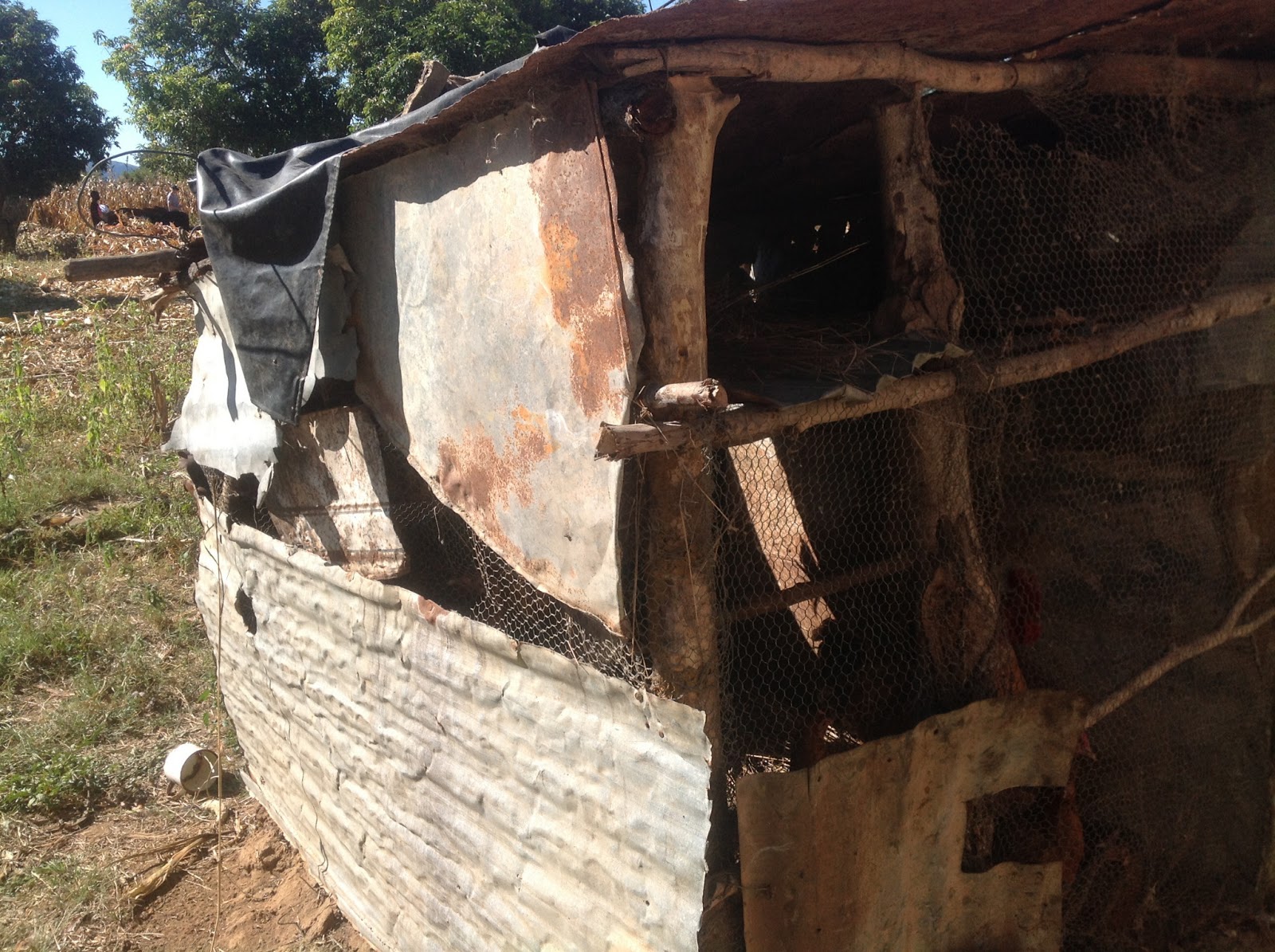
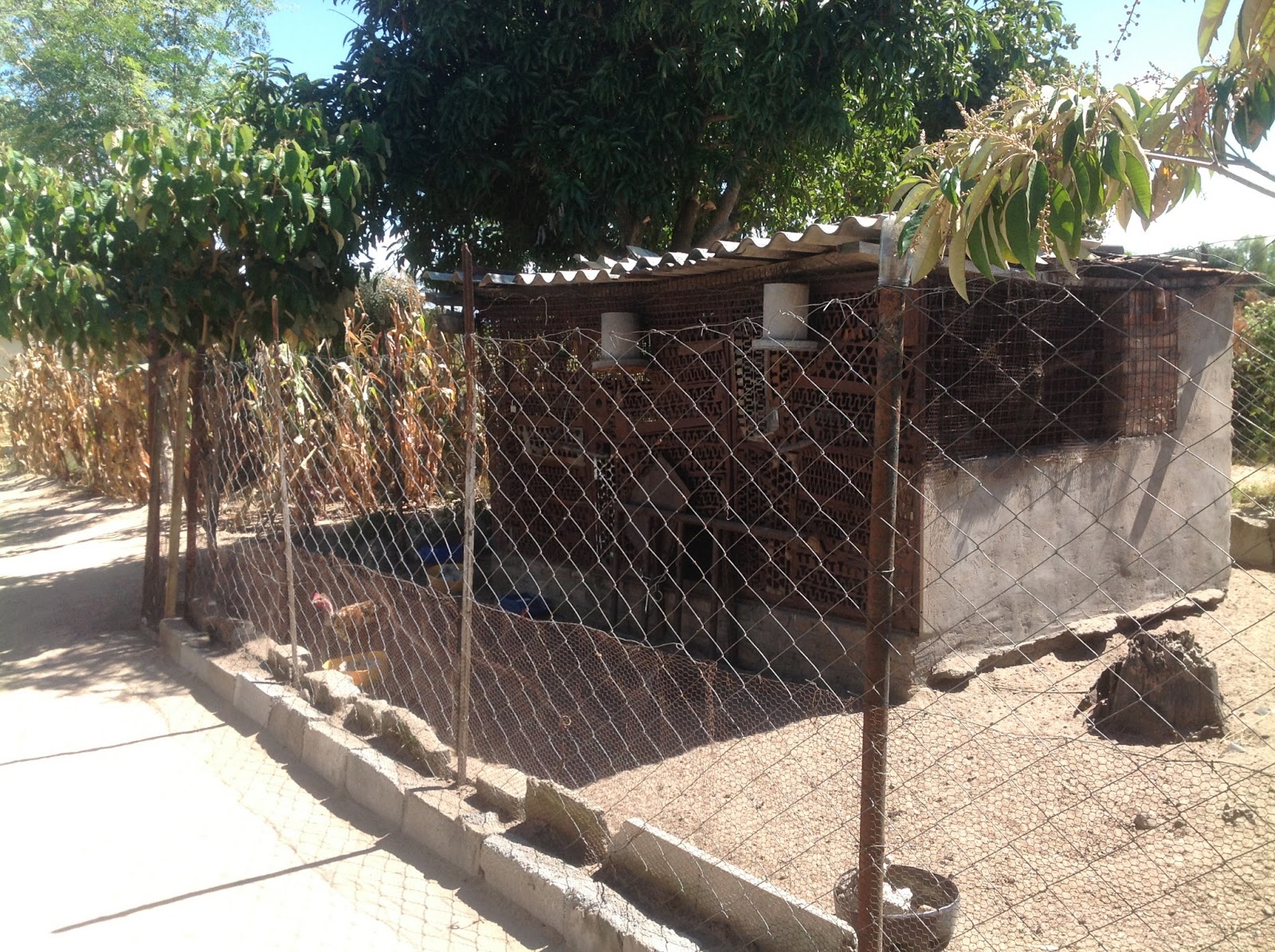
One of the most gorgeous things about visiting the rural areas is seeing the way in which every single thing has a purpose and a value.  The structure above is a chicken coop. 

Chicken coops, even on very affluent homesteads, are often made of found objects that have been welded together.
 Above and below, grates have been welded together for this chicken mansion.


Lifetimes before moving to Africa, as an NYC interior designer I studied a philosophy called Wabi Sabi.  It's a Japanese aesthetic and world view that is based on the concept that beauty and value come from items that are imperfect, incomplete and often marked from their experiences. The life of the object brings it beauty, not symmetry, cleanliness, or solidity. Never have I found better examples than in my time in Africa.

 Here a garden rake and wall grate have been welded with other metals to make a miniature coop.

 Love it.  Above and below glass bottles are used to line herb beds.


Cattle pens made from collected branches line every rural area landscape.

Thursday, November 29, 2012

If Ever You Need Perspective


If ever you need to feel humbled, move to Africa. Imagine moving your entire home full of belongings into a truck for Africa and your feelings at opening all of your items among people who make 100 dollars a month at best. We found ourselves in this position last weekend, when our container finally arrived -four months late, and just in time for Christmas. I was tickled after feeling months of desperation for the things we so "terribly" needed to make home feel like home.  As our gardener's wife helped us to wash all of our kitchenware I suddenly became acutely aware of my privilege.  I felt my face burn as I had Jesca wash boxes and boxes of things like our Parmesan cheese grater, ice cream scoops, and sushi dishes, the likes of which she had never seen, let alone been able to afford.  I quickly shut the door to the rest of the house, filled with containers and Jonas' newly discovered toys strewn about.  I opened the rest of our boxes with curtains closed while I thought about Jesca's boys playing in the yard with their stitched-together grocery-bag ball and felt a large dose of humbleness in my heart.


If ever you need to see the humor in things, move to Africa.  Among other things Jonas and I have been looking forward to, a bike and carrier have been on the top of the list.  We typically walk about four km a day on dusty paths and shoulders of roads in mid-day African heat.  I was tickled to finally have our bikes arrive, newly purchased just for our African commute.  What I didn't expect, though, was how humored all of the local Shona would be with our bikes.  Apparently a white woman zipping around town in a bulky bicycle helmet with a giant trailer wheeling behind her, helmeted baby trapped inside, is reason to stop and smile, to sometimes point, and almost always to always yell, "Mangwanani!  I like your bike!"  I am joyously laughed at with awe so often I preemptively start laughing at myself now whenever I pass someone.


If ever you need to feel cynical, move to Africa. Kurt and I checked each numbered item that came off our moving truck as six men labored in long sleeve uniforms in place of ramps and dollies.  As the last piece found its way into the house, the head mover and Kurt looked at each other.  "There is a lot missing," they agreed.  We went through the lists again, having the movers unwrap every piece of furniture to make sure no package was stuck inside another.  When the movers finally left, we spent the rest of the weekend ripping open boxes at an exhaustive pace, rather than with joyful discovery, trying to recall what and how our American movers had packed, and writing down almost $40,000 worth of stolen items.  Everything from electronics to a computer to table legs to design work to the 75 Christmas ornaments Jonas and I made together last year to the ten books I had handmade for each year of our marriage landed on the list. It rarely happens, though a pair of our friends had the same situation. The items were all accounted for when we arrived in the country, but four months of visa waiting later, seals were broken and bonded storage turned out to be, well, not so bonded.  We are currently dealing with insurance claims and explaining to Jonas why he now has no tricycle or bicycle. Training wheels, yes.  Bicycle, no.  


If ever you need to feel gratitude, move to Africa.  I set aside some of the paper packaging and boxes from our move for Jonas.  He wanted paper to draw on and boxes to build a fort. Upon leaving, the movers asked if they could take the mountain of bubble wrap sheets that had been taken off our large furniture items.  I thanked them, saying, "absolutely," so we would not have to burn the plastic in our yard.  Our gardener pulled me aside hurriedly and whispered, "Madame, can I keep it? I can sell it. People need beds."  I had totally forgotten that many of those who are not fortunate to have mattresses here sleep on scavenged cardboard and, if they're lucky, paper and bubble wrap.  My trash was just what others had been hoping for.  My bed has washed a wave of gratitude over me each time I've walked past it this week.


If you ever want to feel joy for the simple things, move to Africa. I have a favorite family Jonas and I pass every day on our trek; they are squatters who live among the foundational outlines of an incomplete house two streets from us.  We shout out greetings to each other and our babies whenever we cross paths.  (When they first encountered me zipping past on our bike, the father shouted, "HA!  So much betta!  Yo bike is very clever! I see you go fast!  Ha ha ha! Go fast baby!")  They are the happiest family I've seen. The family can be seen doing their laundry in a wheel-less wheelbarrow every afternoon.  One day I passed at an atypical time and watched the mother run full speed from a water spigot to the wheelbarrow, water pouring from the bottom of a holey bucket.  She got a few cups worth into the wheelbarrow, then turned around and started back to the spigot once again.  The beautiful part?  She was laughing the whole way.

If ever you need to feel conflicted, move to Africa. The one most important thing, we were warned by the school, is to never give away from your gate.  If you make the mistake of giving from your door, people will know where to find you.  And their relatives.  And their friends.  Over and over again.  Soon it will be hard to get out of your home.  So when an elderly man came to our gate last weekend asking for money and Kurt, who like myself believes in the value of giving, lovingly said, "Sure, just a moment," into the buzzer, I jumped down his throat.  ((This is after I encountered a begging woman last week that has been returning unwelcome to our next door neighbor's gate for over ten years after she was once helped out when she needed assistance for her sick baby. I admit I heartbreakingly wished her many blessings and denied her the money I recognized she desperately needed in a tactic of self-preservation I have felt guilty about ever since.))  Kurt and I then hissed back and forth with hushed voices about what to do, as he had just led the man to believe he was going out promptly, but I recognized that it would be me trying to get him away from our gate the next time he came and Kurt was at school.  While the man waited, our sad discussion turned to conversation about how we want so desperately to answer the human condition here with a loving approach, that we want to treat all human beings as though they were God themselves, and how much we resent living in a place where the rules of how to live keep our lives safe but make us feel as though we aren't living at the same time.  No matter how we chose, the discomfort of the situation remains present.  In the end, Kurt went out to the gate.  

If ever you need to feel certain, move to Africa. People ask me all the time if I regret moving to Africa, after such a challenging last few months filled with car accidents and visa issues.  My answer is always the same.  

"Never. Look at how much I've learned."

Tuesday, August 7, 2012

The Bubble

We knew it would be a big thought on our minds before we even got here.  We hemmed and hawed about how we would fit into it.  But we never realized it would be on our minds more than finding safe water, or avoiding malaria, or learning that we have to de-worm our child like a dog every six months.

"The Bubble."

That's what my husband Kurt and I call it.  This surreal African juxtaposition of walls and shanty towns, manicured lawns and dirt roads...  And actually, that description fails to describe the jolt that is our new life in an African city of haves and have-nots.  We definitely have been dropped into a bubble.  It's an immediate challenge-- recognizing with gratitude the surreal lifestyle of expansive square footage and amenities anyone would love, while battling the sickening guilt that not everyone is sharing in the blessing.

Though it's not at all our intention to stay isolated among the walls of our new home, which many easily do, please be patient with us. This blog will start in The Bubble. Here are some pictures of our new home, on loan from the school Kurt works for :

 
Our living room, with fire place and a bar behind it. We are calling the bar area our "coffee house" room.  There is no heating or cooling in any of the homes here; just vents on the tops of the walls.  These vents help the house to breath and house large black spiders that come out every night to rest at the top of the walls.  Harmless but eerie.
 
Our back patio, where we occasionally eat.  We will use this space with our two year old a lot during the rainy season.

 
Looking through our living room to our dining room.  Sliding glass door on the left, kitchen doorway up on the right.


Kitchen, full of windows and very large. The back door opens in two pieces, so most of the day with the windows and at least half the door open, the kitchen feels like it's outside. Washing machine, fridge, and pantry on left.

 
Kitchen from other side. Breakfast bar in the middle, oven and warming drawer in back, stove on back right.

 
Master bedroom leads into a dressing room as big as our last kitchen. Two more bedrooms, unpictured, are slightly smaller.  Also unpictured is tons of closet space in every room.

 
Two newly redone bathrooms, both the size of bedrooms.

 
Pool with fountain (out of picture) looking at one of our patios.


Trampoline on the side of the house.  Our Jonas is in love.  I call it a death trap, but he's already used it for about three hours, so my hesitations have not meant much.  There are probably more dangerous things in Africa...

 
Looking to our back yard from one of our three patios.  A children's playhouse (again, death trap) sits in front with a large area of gardens, fruit trees, and stone benches behind.  Also unseen are the staff quarters... a separate cottage, shed, and burning area.  The yard is approximately two acres.

 
Kurt and I laugh that we had to move to Africa to live on our first cul-de-sac.  The black gate is ours.  We have yet to meet the neighbors, whose ferocious dogs have kept me at length.  Dogs here are for protection, not cuddling. We all live behind gates and walls, with barbed wire and electric fences unseen above them all.

 
Coming into the gate.  Every piece of green space is manicured... It hasn't rained since February, but you can't tell. Can't wait to see the water bill!