Showing posts with label what a story. Show all posts

Tuesday, June 16, 2015

The Top 10 Things I Learned in “The Good Old Days” of Africa


Here are the top ten things I learned while living in Africa:


1.  The things you take for granted, someone else is praying for.  Let’s get the most obvious thing out of the way.  Africa made me grateful.  

There are struggles that generations upon generations of our ancestors dealt with at one time that many of us First Worlders now do not even think about most days.  I have clean water miraculously come out of a spout in my kitchen.  I flush the toilet and never have to see the contents of it again.  I can call 911 and people will actually come; paramedics...  firefighters...  police... A system is in place and people will actually come when I need help.  My First-World doctor will most likely not turn out to be a veterinarian.   I open the refrigerator and assume the electricity has been on all night to keep things cold.  Said refrigerator usually has food in it; and when it doesn’t, I can resource more of it independent of how well the weather treated local crops during the growing season. 

I am grateful for the comforts I grew up not knowing were comforts. Until the day I die I hope I always look at my bed as I have every night since moving to Africa.  I do not sleep on the ground; I do not sleep on bubble wrap, or cardboard, or a piece of wood.  I remember back to when my gardener asked me for my moving boxes so he could sell them to people for beds and I think, “Dang. I’m lucky.”

2. It’s a very very small world.  I thought I knew this lesson, but apparently I didn’t know it well enough. I grew up in a teeny tiny town in the middle of Iowa. I was blown away by the fact that every time I walked through Times Square I ran into someone I knew. “It’s a small world,” I would say.  When we moved to Africa and met coworker Jon, it took us literally two minutes to realize we had both grown up within a fifteen mile radius of one another. “It’s a very small world,” I had said.  But it was on the day I saw a re-sold tee-shirt from my high school being worn by a native African on my street that I truly knew. It’s a very, very small world.

3.  Luxury is having a thermostat.  This may just be the most intelligent thing I ever say so please take note. Luxury is having a thermostat.  My ability to manipulate my surroundings in the First World is. Un. Real

4. You only learn as much as you want to. *I started to realize it when I moved to NYC and was amazed that instead of finding worldly-aware citizens, I found people who could tell me ten ways to get to Times Square but could not find the state of Iowa on a map. *I started to realize it when I moved to NYC and found worldly-aware citizens that could discuss the implications of an MFN trade status with China and the effects of trade embargoes on small villages in rural Cuba, but did not know how to buy a subway pass.  *It clicked entirely when I moved abroad and was amazed that instead of finding locally-aware Zimbabweans, I found people who did not know the pangolin -one of the most sought-after animals in their country- even existed, but knew Snooki’s catch-phrases from MTV’s Jersey Shore.  *It clicked entirely when I moved to Africa and found locally-aware Zimbabweans that could discuss the tragedies of the monetary incongruities of white-African versus black-African farm-ownership in Zim, but did not know that the n-word or k-word is not an acceptable term to most English-speaking people.

I found the same tendencies in people wherever I went.   A person can choose what they care about and what is relevant to know in order to navigate daily life.  Getting outside your walls (literally, in the case of walled-Africa) and choosing to learn about the diversity of culture found in your own hometown?  That is entirely up to you.

5. Wealth is not about how much money or possessions you own, it’s entirely about access.  This is not just a sentence; it’s a whole college class.  I am American and I take a few things for granted, feeling poor when I look at my wallet or bank account. But, if I want to buy a car, I get a loan.  If I want to go to school, I get financial aid.  If I want to buy something, I can buy it even before I have the money, instead using a nice little piece of plastic.  I have access to things simply because I am an American with a social security number.  If my Shona housekeeper walked up to a bank to ask for money, she’d be turned away before she even got to speak to someone.  In Zimbabwe, you buy nothing that you do not first have money for.  If you don’t have money, you don’t eat. Want to go to school?  Save up for it first; you cannot borrow your future.  Every time I felt frustrated by my American student-loan debt, something most Africans have no concept of, I had to stop and remember; my thousands of dollars of debt is worth more than the five dollars in the pocket of a Third-World citizen.  It’s all about access.

6. Living in Africa is like  driving with the windows rolled down. You try to orient yourself while challenges come at you at high speeds and your hair whips in your face.  You can feel the air, richer than any oxygen coming out of mechanical dashboard vents, and you can smell the earth.  Sunshine sits warmly on your arms and you feel alive, though perhaps a little disoriented and overwhelmed and nostalgic for the unnameable. Life is raw and real, out in the open.  You will leave refreshed.  But you will look like a mess.

7. The 1950s are alive and well. We first noticed it on the rusty metal pipes that made-up most of Zimbabwe’s playgrounds.  We saw it in the backseats full of bouncing children playing with lighters but sans car seats. We saw it in the 30 year-old medical books our vet-doctor referenced in place of a computer. We saw it in rusty vehicles held together with tape and prayers. We saw it in the gross treatment of staff, as though it was the mid-century American South.  We saw it in kids drinking out of hoses and sunburns welcomed on blistered white children who had never worn sunscreen in their lives. We saw it in the use of non-politically correct words that made our ears blush, and crank cash-registers that made our child’s eyes light-up.  We saw it in the motor-oil used to finger-print us at the police station, and in the misplaced paper files that delayed our many governmental registrations. Just because people know about technological/societal changes does not mean they want to embrace it, or have access to do so.  It’s awesome to talk to a Zimbabwean about “the good old days” –and most people do love that subject- and to realize that the generations I am speaking to in many instances are decades behind our American concepts of “the good old days.” Not everybody got the car or the computer at the same time.

Image by nairalandnews.com
8. Africa has everything.  Cities. Mountains. Deserts. Plains. Waterfalls. Swamps. Forests. Volcanoes. Jungles. Kopies. Cave paintings. Art museums. Suburbs. Upper class. Middle Class. Economically challenged. Orphans. Danger. Safety. Healthy living. Polluted squalor. Democracies. Oligarchies. Tyrannies.  Street vendors. Shopping malls. The wild. The developed.  The clean. The dirty. Penguins and winter.  Pyramids and burning sand dunes. Colonial-formal. Rural-improvisation. Mother Africa has it all.


9. Write your love letters to home.  Nothing will make you feel more like a part of something than when you are separated from it. I never felt so American as when I moved out of its borders.  I adored countless things about my African days. I could gush for weeks.  But I surprisingly discovered –sitting in the differences- what it is I love about home.  Absence makes the heart grow fonder.  And perhaps a little more grateful, too.

10. You can’t go back.  The bright shining continent of Africa will live with me forever, whether I make it back or not. (And I do plan to!) As Andy Bernard said so accurately on The Office, “I wish there was a way to know you’re in the good old days before you’ve actually left them.”  We are always in the good old days. We’re in them right now. But the tragedy about trying to go back to a place you love is not just a question of geography.  It’s about who was there, when, and how, and why.  My baby grew up in Zim, he ran barefoot climbing mango trees and giggling as we chased giraffes in our jeep and caught frogs in our pool. We felt the spray of Vic Falls and the dry heat of Mana Pools.  We basked on the Zambezi and cuddled orphan babies we eventually cried about putting down.  The ways I got to experience the Great Continent That Could were a gift I will return to a thousand times… but only in my mind.

Tuesday, July 1, 2014

“The Africa Blog”


Today we fly out of a spectacular place we have been privileged to call home for the past few years.  As we fly off with our eyes brimming and our hearts a little emptier, it is hard not to romanticize a place we put a lot of energy into knowing through the eyes of our privilege, our special trips, our involvement in the international school system, our work in orphanages, and the local populations we came to know.  

As our move has progressed, oodles of people have been asking me, “Please will you keep writing your Africa blog?”  When I started writing Well It’s Africa, separate from my family’s personal blog, this blog’s purpose was to communicate with family and friends far away.  We wanted to introduce those in our lives to the new things we experienced, the places we have seen, -and for some- to show them just why they need not fear for us in a place so different from where we started our journey as white babies born in the heart of the American Midwest.  My readership has somehow grown from my sweet little group of family and friends to over fifty thousand to date, a number that often hurts my brain. As this blog has evolved, it has come back to me from friends of friends of friends to complete strangers, often saying things like

“This makes me sick for the Zimbabwean home we left!”
"This blog helped me prepare for my move to Southern Africa."
“I love seeing Africa from a foreigner’s eyes!” 
“Your blog reminds me of my African childhood!”
“You’re encapsulating the little things we don’t even realize are different from the rest of the world.” 

So let’s answer this question, "Please will you keep writing your Africa blog?" For better or worse, (hopefully better?!)  I will indeed to be continuing this blog until I have no more to share about Africa, however long that is.  

As we move on from this continent that still feels new in some ways, the process of detangling oneself from what we have come to know as “normal life” will take some time.  As we process the things we've learned and continue to share the stories we still have to tell – this time within the freedom of our American society instead of with the fear of our Zimbabwean big brother looking over our shoulder- I hope you’ll continue joining me.  Zimbabwe has a number of changes ahead of itself, and I can't wait to watch where it goes.  My life in Africa may be over for now, but there isn't a soul that could separate me from the experience.  Today I carry it heavily on my shoulders, in full arms, at the pit of my stomach, and deeply within my heart as we leave a magical place we've been blessed to call home, my beautiful Zimbabwe…

Thursday, April 24, 2014

Sinking in Quicksand


There really is nothing quite like being trapped in an eerily silent African forest with a four year old as the vehicle you are sitting in slowly sinks in quicksand.

If you read my other blog, you’ve just heard this story. Sorry for the repeat, but it is one story from Africa that will stick with me for a long time.  That’s because in what can be described as one of my worst parenting moves thus far, our lack of taking Africa seriously landed us in quite a pickle when we found ourselves stuck in quick-sand miles from any other human being or cell-phone signal.


After a lovely English breakfast, my husband Kurt and I put our four year old Jonas and Bostonian friend Lucy in the car for a lovely day out in Matopos National Park.  The plan was to scout out the park’s most famous inhabitants –endangered rhino- and other happy wildlife from the luxuries of our all-wheel drive Honda CRV.  There are two sections of the park.  One is highly visited, full of prehistoric rock art, camping grounds, and the View of the World.  The other, though known for its wildlife, is less frequently visited.  And by “less frequently,” I mean we were the first of two cars to visit that morning. Also important to note, the rangers at the front gate –not surprisingly- had no vehicle.

 
Of course, we didn’t have sneakers or socks or bugspray.  For that matter, we didn’t have a car-jack, a tow rope, cell reception, a shovel, flares, first-aid kit, weapon, or a back-up plan of any sort.  Why would we possibly need those things?   Just taking a drive in a national park before a lovely afternoon at View of the World (another blog post to come).  Thank God we had water, sunscreen, and a sense of humor.

Kurt is an excellent driver, but no one could see this one coming…


We spent two hours wading in water and sinking in sand as we moved every branch we could find into a hilarious sculpture that looked… ahem… a lot like a still-sinking car.  We dug. We put our floor mats under the wheels. We spun. We pushed. We fried in the sun. We taught Lucy about a parasitic snail found in water and promised to buy her some medicine first thing when we returned home. We laughed when I spun the wheels but forgot to roll up the windows.  We sunk more. We watched our backs for lions and leopards. We literally tried to pick up the car. We prayed and Jonas cried.


It was clear.  We were not getting out without some major help.  The conundrum was whether to abandon the car and walk through lion and leopard territory while trying to urge a four-year old on, or to wait in a sinking car until A) someone whose vehicle just happened to be equipped like a tow truck came upon us, or B) dark, when the ranger station would hopefully realize we were missing and try to borrow a vehicle to find us.  Options were not so good.


We looked at Jonas, who of course chose that particular moment to desperately need to poo outside for his first time ever and decided only God knew how long that would take.  We had to split up.  Kurt and Lucy went on foot with water in hand to bake in the sun as they headed for the park entrance 15 kilometers away.  Though we didn’t make a dramatic thing of it, inside I had enough drama for a whole Shakespeare company.  There really is no worse feeling than being left alone in the middle of the African bush with a four year old needing entertainment and comfort while you run through scenarios of what to do should a predator attack you and whether you will ever see your husband and friend again.  I quietly took a photo as Kurt and Lucy walked away, in case it was the last time I saw them.  Then Jonas and I eventually sat to bake in the sun inside our sinking car (fewer lions in there) and waited.  Alone.  I finally gave in and handed Jonas my iPad, creating a computer-addicted monster for the rest of our vacation in less than a minute.  Desperate times call for desperate measures...


Kurt and Lucy made it about 8 kilometers before miraculously coming upon the only other vehicle in the park, driven by none other than a local church minister.  Alleluia! Talk about heaven-sent. Kurt’s only question? “Do you have a tow rope???”


It took an hour of maneuvering: pushing, pulling, moving, jerking, and shifting loads.  The tow rope broke four times until, when we finally got out, the rope was so embedded around our car hooks that it could never again be untied. We cut it with a knife under the car, dragging a foot-long section of rope during the rest of our week until our gardener spent over a half hour cutting it loose from the undercarriage of the car when we returned home. Whenever we saw it, the rope served as a good reminder: Sometimes divine intervention will get you out of sticky situations,  but always be prepared when on safari.

(celebration lunch!)

Monday, March 24, 2014

Fierce Finishes to the Rainy Season

African skies always love to pretend that nothing happened.  When we awoke Friday morning, birds chirped and a bright blue diadem with puffy white clouds shined overhead. One would never guess that the night before we went through a storm I can only liken to my experience living through 2011's Hurricane Irene.  Though this storm was rather quick, the clean-up will be anything but.  Six days later, the sounds of chainsaws buzzing through the neighborhood are still going strong and our electrical wires still hang in mangled messes throughout the neighborhood.  Sigh.  We are told it could be a few weeks before our power and internet are restored.  In the meantime, I will apparently be spending a lot of time at Kurt's generator-powered school.

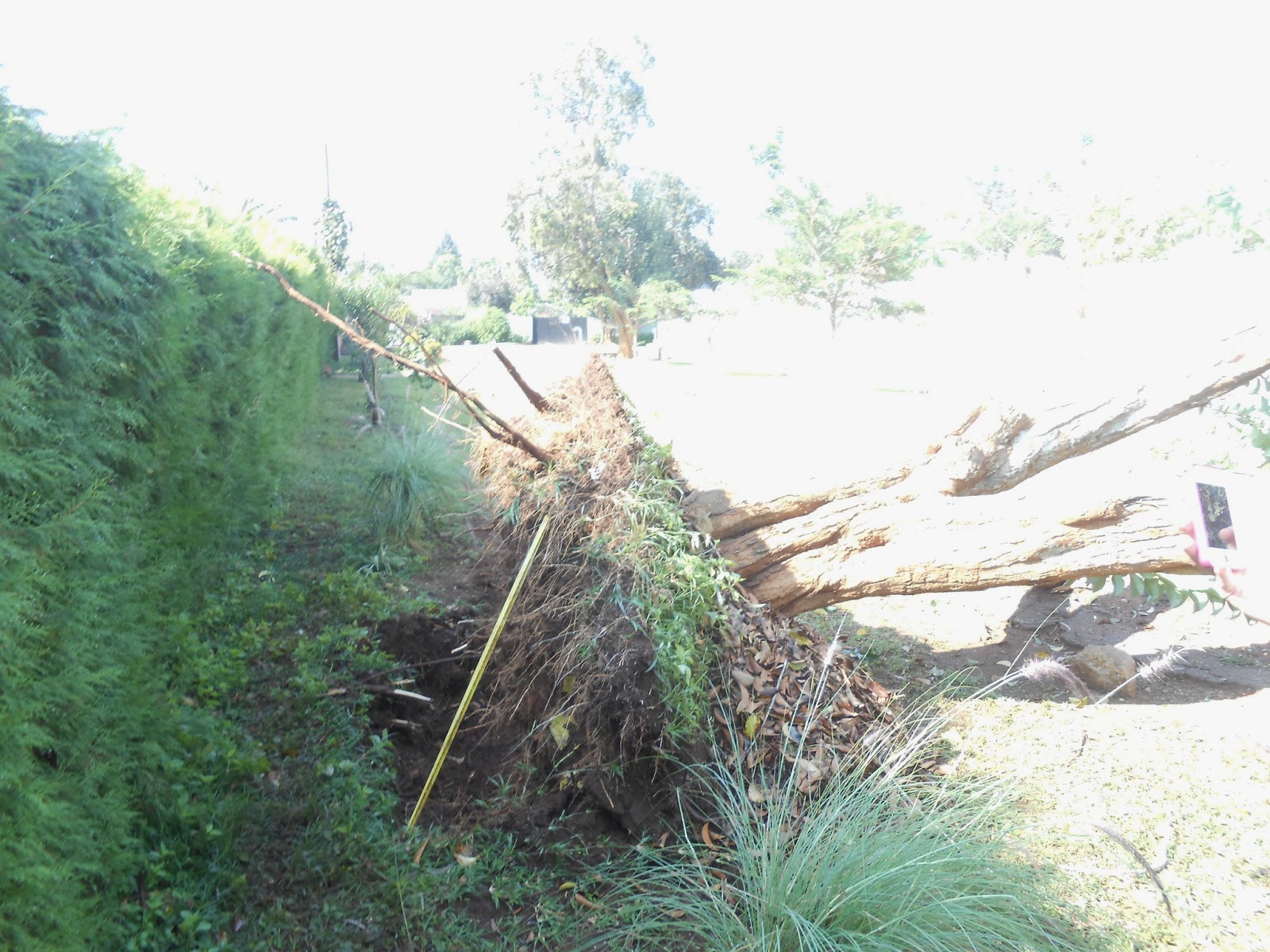
Our neighborhood received the brunt of the storm, with downed trees blocking roads on nearly every block.  WHAT a mess; we spent the day searching out petrol and groceries before watching a chainsawer spend eight hours massacre-ing 15 of our trees.  Meanwhile, most people were just thankful that no one anywhere seemed to have been hurt.  As we celebrate close calls and a plethora of firewood literally fallen from the sky, here are some pics of our/ our neighborhood's new challenges:

 Here is one of three sections of roof we are now searching for.  
Anyone seen the top of our chimney?


 Despite anti-burning laws in the city, from the looks of our (not even close to finished) twelve foot high pile, my guess is the neighborhood may be smokey for quite a while.


 I found it surprising to find oodles of tall pine trees upon moving to Africa.  The problem with them here is that their roots and the soil make for a deadly combination.  These toppling giants are hazards found all throughout our neighborhoods.

 We were unable to get out of our close (culd-a-sac) because of a downed tree.  After learning that the neighbor whose tree it was could not pay for the removal, us (albeit trapped) neighbors all pitched together to get the bill taken care of.

 Gotta find humor in the fact that the underground internet cable (above, yellow) just connected last week was pulled up by the only tree that fell on the close.  

 
Making new roads to get to the petrol station...

 
 Meet our (newly redone) power lines. (Surrounded by tall wobbly pines!)


 Four days after this tree is still on the road… and my power lines.

 
(Above, right) here bamboo poles are used to get ropes high enough on our tree to pull it away from the power lines before the cutting starts.

 
 (Above, right) Watching trees being taken down may be one of the saddest things I've ever seen.  Sigh.  We loved that tree... Fourteen more to go.

Sunday, March 23, 2014

The African DMV: “How did we get here?! Here??”


As our friend Julie loves to quite aptly point out, there are moments when we look at her family and ours and say, “How did we get here?!  Here.” Surreal, strange moments have abounded for us Americans as we’ve navigated life in Africa after growing up in a different concept of normalcy.  Crazy moments. Traveling across South Africa with all of our possessions in the trunks of three identical cars.  Screaming and retreating into the house after our mango picking was interrupted by swarms of mating termites gathering in our hair.  Cleaning dead birds out of our kitchen sink while looking for delinquent elephants a remote three hours from the nearest semblance of a village. Watching the aftermath of a housekeeper who convinced Julie’s teenager to drive her to pick up a stolen bathtub when his parents were teaching school.  Just a few weeks ago Julie and I found ourselves in a doctor’s office together, answering each other’s questions regarding frequency of diarrhea before learning that said doctor – who we’ve been going to for over a year- is actually a veterinarian. And then last weekend, baking in a hot car while my four year old, Jonas, Julie, and I banged our heads outside of the African equivalent of a DMV (Department of Motor Vehicles) we watched a man carry a perfectly balanced queen-sized mattress down the street on his head.  “How did we get here?!  Here.”

Life is weird. 


On a whim my four year old, Jonas, and I found ourselves at the equivalent of a DMV (Department of Motor Vehicles) in the village of Bindura, an hour north of Harare, with our friends, their 16 year old daughter Megan, their gardener, a crowd of thirty, and a shotgun wielding guard. As husband Kurt was living it up in a South African hotel of endless food and actual showers, Jonas and I found ourselves easily entertained by the quirky eccentricities of the drivers-permit testing system and a baseball and glove.  And boy did we wait.

Why we thought the trip would be fast, none of us knows. 

I’ve had some long hellish experiences in the American DMV system, so add a sprinkle of Africa into that and you have a hilarious waiting game involving expired IDs, delayed tests, cramming from the driver’s manual, and some great demonstrations of what not to do while taking a test drive. Though gardener Tapiwa had taken the test twice in our city, bribery (or in his case, a lack of) had gotten in the way.  Now we sat with Tapiwa and Megan in this small town of Bindura, surrounded by anti-bribery signs and rifles. It would have been perfect.  If Tapiwa’s ID hadn’t expired since his last test.  Megan went on to take her test, having studied for weeks from a manual with questions like this:  


(c) when reversing

(a) adjust the mirror because obviously it's pointing at the sky

(c) the meaning of life

(c) reversing… because why be cautious at any other time?

(c) no… though if the kid's eleven, all bets are off… I love how all of the true/false yes/no questions always have a weird third option.

Most people –if they can scrape together the money- find themselves repeating the written test over and over until their ability to reason has eventually been tainted enough to find hidden logic in questions like the ones above.  When Megan came out of the testing room, she explained how every student’s test score was announced out loud after the instructor corrected it with the seated class in waiting. But testers never got to see their test again to learn what they had done wrong.  So in the case of Megan, who was just a teeny tiny two questions shy of passing, she could only guess what would have to be changed the next time she lined up for another five hours of DMV fun.

In the end, our car of six people drove away silently, hot, hungry, deflated, and empty handed except for a few pictures of some entertaining signs, and some special rocks Jonas had found in the midst of the driver’s test parking lot.  I couldn't help but once again wonder, “How did we get here?!  Here.”


Tapiwa, Megan, and Jonas cram in the car.

 
Megan and Tapiwa wait at the end of a very long early morning queue. It almost makes things seem organized, doesn't it.

Jonas looks on from the parking lot while the sun heats up.

Cramming during the wait.

A man with a rifle checks IDs before moving applicants around the corner to another queue.


I thought it would be funny, but Jonas was not so excited about getting his picture taken in front of this sign.  Good thing Dan was so enthusiastic.