Monday, October 13, 2014

Best Creature in Africa: The Baobab

I am ashamed to admit this: when we first arrived in Africa, not only did I have no appreciation for the fat trees that showed up on every artists' canvas, but I thought they were down right ugly.  Then I came face to face with one.  And I was never the same again.

I have mentioned them in tiny ways before.  But when I close my eyes and think of Africa, the bright sun and the baobabs are what spread across my eyes.  

I call it a blessing to have crossed paths with these incredible giants.  My pictures will do no justice; Oh, promise me you'll google them. You'll be so happy you did.


Friday, October 10, 2014

Happy Harare

I've been meaning to post it for months, but my recent lack of time seems to make this the perfect moment to show you some tidbits of my African hometown.  With the recent healthcare challenges surrounding ebola outbreaks and the understandable but depressing reports of poverty crises defining most of the First World's focus on the continent, undoubtedly Africa could use some positive representation.  Congrats to my dusty city, dancing in their recent coming of the rains.  

Reuters may have so far deemed it the century's "least livable city in the world," but I'll answer that claim later.  For now I will truly cherish this video, complete with people we know and places we go.  A little taste of the Harare few outsiders get to see:  


https://www.youtube.com/watch?v=g1CNgQhf8bA

Wednesday, October 8, 2014

Fifteen Things


What a busy week!  I just read an article explaining how women let their blogs "go cold" alarmingly more often than men.  While to do lists and mulling over large ideas have got to be on the list of explanations I'd give if guilty, let's not let this blog get any colder.  While I am putting out fires on a different continent, here is a wonderful blog post I'd like to share with you.  If you haven't learned some of it from following Well It's Africa, hopefully this blatantly stated list will get you thinking, too...

Fifteen Things You Shouldn't Believe About Africa:


I love number eight.

Tuesday, September 30, 2014

Hunting the Hupu


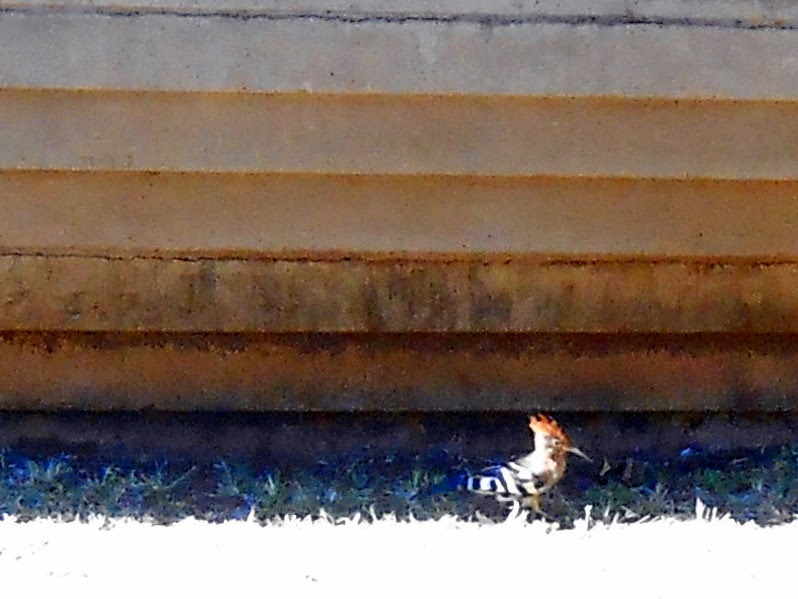
If for no other reason, our gardener thought I was crazy because of my stalkerish tendencies with one particular animal in our garden.  Meet the shyest bird alive... my African favorite, the hupu.  It took two years and this is it.

Four pictures.

These were the best pictures I got of this elusive, crazy creature that was always tauntingly sitting just outside our kitchen window.  Google this bird or click here to see what is also known as the "hoopoe."  It may be the national bird of Isreal, but this guy will always look like Zimbabwe to me.


Sunday, September 28, 2014

If International Travels Have Taught Me One Thing...

it's that everybody wants TV.


Harare's most infamous slums: overpopulated, cardboard walls and beds, no windows, no plumbing.  But plenty of TV.


Wednesday, September 24, 2014

Gems on the Side of the Road

My final road trip in Zimbabwe ironically served as the perfect summation of my two years in the country.  We had just come from riding elephants with my four year old, as an unforgettable, perfectly perfect last hurrah he is still talking about. The sun was heating in the morning sky, the ground was sweating off its dew, and we were sailing over a smooth highway full of cars and combis on their way to the city.  Then BOOM.

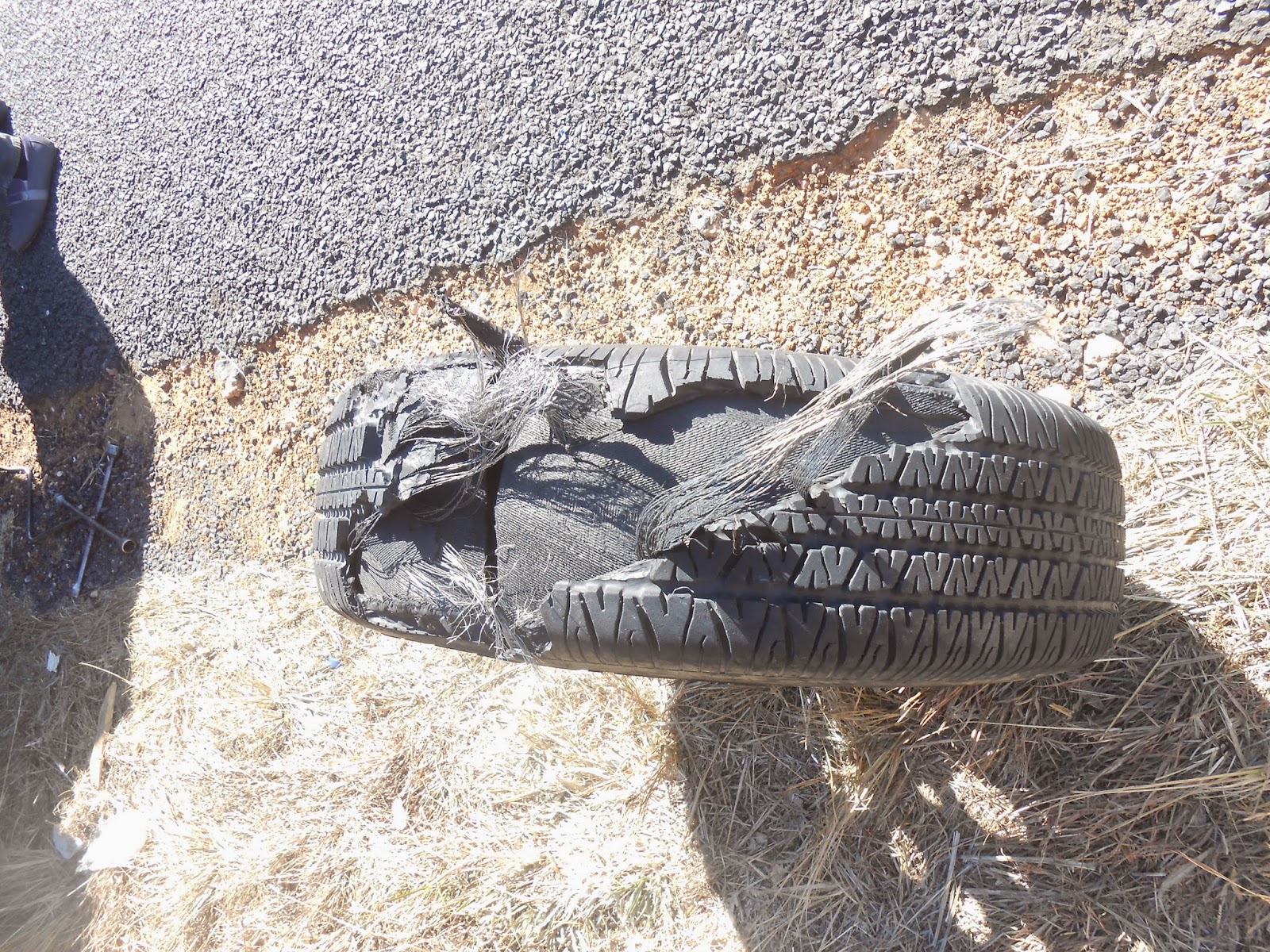
A giant crash and a pulling steering wheel yelled for us suddenly to veer to the side of the road.  We pulled to a stop as Kurt and I looked at one another. Definitely a tire.  We walked to the back of the car as a worried Jonas pressed his face inside the window.  The tire we had just bought the previous week had blown away from the rim, which now sat on the pavement.  Our last 100 meters of highway was littered with what looked like black grated cheese tauntingly waving at us in the breeze. 

We both knew this was not good and a feeling of déjà vu came over me as I thought about our lovely afternoon months before spent watching the same car sink into the quicksand.  It was one of four last days in Zim.  Most of our fellow co-workers and friends have left the country for winter break just days before us.  We had no jack.  And of course, we had only a few minutes left on our phone. The only friend who answered us was stuck in brunch with her in-laws.

A combi pulled up in front of our car and a man jumped out as it slowed to a stop.  Kurt went to speak with the man and as I watched I had a terrible feeling from the body language that the two were negotiating.  I had a bad feeling as Kurt returned to the car.  Before he even said anything I butted in, “That guy seems like bad news. I don’t have a good feeling about him.”

 “He wants twenty-five dollars for a jack.  They say they’ll drive away as we use it and then have me give the jack back to them in Harare… but they won’t actually show me the jack.  I told them I needed to go back to the car to check if I had that much money, but really there’s no way—” He was cut off by the screeching of tires as the combi sped away.  It was clear the men had no jack and had just wanted to see if a desperate guy on the side of the road would hand them cash before they made their getaway.

Next I called the place we had just been riding elephants and spoke to the owner.  I explained our situation, simply asking if it was safe to be on the roadside, and what they recommended we do.  Really I was hoping that perhaps he or one of his men could drive the 10 kilometers from their location to help us as a nice gesture to a customer. The owner hemmed for a moment, then said, “What color are you?”

This was not the first time I’d been asked the question, though it had taken me back.  “White,” I’d said plainly. Wonderings of discomfort crept into my brain as I thought about just how it would feel if I were so clearly helped or not helped simply because of my color. 

The man continued, “Okay… If you’re white, someone will eventually feel safe enough to pull over. If you’re black it’ll be harder. Call us back in an hour if no one stops to help you.”

We spent the next twenty minutes watching drivers of all colors and economic brackets zip past us until eventually, a man named Abed slowed his barely-sputtering pickup across from our car and motioned Kurt across the highway.  Abed became our saving grace, having not only the rusty old jack to do the job, but getting down on his hands and knees to do the dirty work as traffic whizzed dangerously past.  Abed was a quiet man, but carried himself as though he were grateful to have the opportunity to help someone else.  It was an incredible gift that seemed to be a direct answer to our frustrated prayers. And suddenly, our problem was gone.

Abed never asked for money or gave us the slightest indication of anything other than being a good neighbor.  Still, I couldn’t help but wonder if a piece of him had hoped for a little something to come out of his good deeds. Certainly if this was the case, I absolutely preferred his loving entrepreneurial spirit to the mean entrepreneurial spirit of the men in the combi.

Kurt slipped Abed a little cash, and as we waved our goodbyes and gushed thank you’s to Abed one last time I couldn’t help but think that our experience that afternoon was the perfect definition of Zimbabwe.  As Abed’s rusty truck pulled away, I was reminded of the different kinds of people we found over and over in our time in the country of Zim.  There were those who wanted to take advantage of the misfortunes of others to get ahead.  Those were the people who made me skeptical and untrusting, and worse, made me feel entirely alone and helpless. There were those who waited, like the owner I called, ready to add in his opinions, but not quite ready to be prompted into action.  Then there were those friendly souls like Abed who were willing to go out of their way to help a fellow human in need. 

Zimbabwe was once considered the gem of Africa.  For sure it was no utopia, but it was ahead of its neighbors economically, feeding its people as the “breadbasket of Africa” with successful farms, making its own brand of cars, supporting the continent’s textiles with its homegrown cotton, and enjoying the highest literacy rate in the world. The mighty has fallen for a number of reasons that can be talked about outside the context of this quick little post.  But what is more important now is how to get it back on its feet.  I don’t have easy answers, or a well thought-out plan, but one thing is clear.  We made a lot more progress with the man willing to work alongside his fellow human beings in need, no matter what their color, than from the people trying to get ahead themselves. Thanks, Abed.


Saturday, September 20, 2014

That's All Yolks!

After years of being confused by why Africans put their eggs on the shelf and Americans put their's in the fridge, I finally have an answer!

Why the US Chills Its Eggs and Most of the World Doesn't:

http://www.npr.org/blogs/thesalt/2014/09/11/336330502/why-the-u-s-chills-its-eggs-and-most-of-the-world-doesnt


Monday, September 15, 2014

Afterthoughts: The Dirty Little Word

It's a lot to process, this unseen transition that takes place when one suddenly finds oneself waking up in a "First World" country once again.  Blogging in my African garden months ago, I thought I would have a post or two about my time leaving.  But something now tells me that the learning and wisdom that comes from rewiring oneself onto a new continent may just expand in a slow rising for the rest of a lifetime...
- - - - - - - - - - - - - - - - 

There is a dirty little word the ex-pat community in Zim whispers quietly, never speaking too loudly, lest it be misunderstood.  

Listen closely, because I'm nervous to say it out loud.  

DeAfricanization.  

This word could mean a hundred things to a hundred people, and many of the definitions could have an understandably negative connotation for sure.  But I want to let you in on this secret little word, whispered by anyone preparing to leave the home they have come to know on a shiny, hair-pulling, beauty queen, beast of a continent called Africa.

DeAfricanization. Whether you like the term or not, it's being used by expats everywhere, as the concept that there is a transition one goes through when leaving the continent.  It's more than just a needing to become desensitized to the sudden sensory overload of signs and ads and billboards and media barraging from every angle after stepping off a plane.  It's more like an involuntary, personal, mental-quarantine of sorts, that takes place while a person comes to terms with the Third World problems that suddenly no longer exist at the front of conscious thought when one steps into a First World country.

It's understood that the longer one's been away from the First World, the longer it takes to make the transition.  But it's also understood that the more Africa has gotten in your blood, the more it pops itself up. At random times. In random places. When you least expect it.  With brighter colors and without the smell of urine or the feeling of cracked heels.  Maybe a bit romanticized.

 I'd be lying if I said I don't still have Africa tapping me on the shoulder a number of times each day.  But here is one example in particular that I had just a week and a half off the continent, when I came to see exactly what it meant to realize that the technological world had not stopped its "progress" while I had been a way for a few years.

Among other things, my sister's middle name could be One-Who-Does-Not-Get-Embarrassed.  So I knew my behavior was not the best when my sister, standing next to me at the public library in her town, looked around with a blush on her face as I angrily spoke to a man behind the counter.  But I just couldn't believe it.  I had just spent weeks worrying about what would happen to my staff.  How I would leave my friends unemployed in a country with an unemployment rate in the 90s and the third lowest GDP in the world.  I knew the value of employing people, of giving a human being work to provide for his/her self and family.  Africa taught me that.  And I was not going to forget it.  Then I walked up to the counter to check out my books, and realized that some people already had forgotten.

In place of a smiling librarian, ready to scan my books, I instead came face to face with what has become the bane of my existence at every American grocery store: the self-checkout. A machine that never fails to slow me down tenfold after raising my blood pressure tenfold.  I looked at it for a moment. Then I got in line at the old-fashioned circulation desk, waiting my turn rather than taking a decade to convince the computer I really was trying to scan a bar-code.  When the librarian ushered me forward, I handed him my pile of books.  He promptly pointed me to the self checkout.

"Can I not check out here?"  I'd asked defensively.

"Why?  Is there a problem?"

"I'd rather use a human than a machine," I said handing him my first book.

"No, we don't do check-outs anymore.  You'll have to use the machine."

"Really?  Your computer's not capable?  Can't you just scan my stuff, since I'm already here?"

"No.  Is there a problem with the machine?"

"No..."  I stared at him.

"Is there a reason you cannot use that machine?"

"I just like employing people... I'm giving you work." He looked at me like I was crazy.  Could this man not see that his very job was at stake when he was letting the computer do his previous work?!  Didn't he know that I was just trying to employ people? Were computers taking over the world? Oh, why wasn't I in Africa where this would never be a problem?!?   I was lucky to have One-Who-Does-Not-Get-Embarrassed with me, or I know I would have ridiculously made a scene that had little to do with the man and everything to do with the changes I found myself unready to witness.  I was being ridiculous, but how could I have just come from a place where people were dying to have a job to one in which people were happy to hand over their work?  Didn't anyone else see?!?

Over the next few weeks I came to see that technology hadn't just changed at the library. There were iPads swiping people's credit cards at the farmer's market. We got our restaurant bill on a tablet right at the table before signing and leaving without ever touching a receipt.  I walked through a food court at the mall and realized that this vendor does not take orders any more; you simply walk around the corner and pick up your food:

And suddenly, telling someone to hold the pickles on a hamburger takes
 twelve extra minutes as one navigates how,
exactly to ask a single question or make a single comment on an "easy order."

Even my four year old had noticed the technological differences in the US.  Our check-out woman had laughed at us one day as she looked down at Jonas. "It's as if he's never seen a check-out belt before!"  Not that he could remember.  And suddenly I realized.  Jonas' excitement at seeing fire trucks. And traffic lights. His amazement at seeing deer.  His pointing out of every neon sign we passed. His love of bulk-bins at the grocery store.  Jonas was going through his own silly version of deAfricanization, too.

I recognize everything would have changed had I been in Africa or America or anywhere else in the world.  But the difference was stark and the shift in reality was real. I was glad to have a term, the little secret word, to put a name to what I was going through.  And for the hundredth time in a week I had to decide whether to just smile or to explain that we had just returned from two years in Africa.

Sunday, September 7, 2014

Kutie

Upon moving to Zim, my husband Kurt found it warmly amusing that many people had a hard time pronouncing the “urt” sound in his name, and often instead left out the “r.”   I have always called my husband “Kurtie,” but had no idea that would affect how the Shona interpreted us.  We found it hilarious when we eventually discovered that for over a year our staff and surrounding loved ones thought I was referring to my husband as “Kuti,” which it turns out translates into “just because.” 

A birthday tee-shirt was in order.


Tuesday, September 2, 2014

The Rhodesian Boiler


Meet the Rhodesian Boiler:  Zimbabwe's version of a wood fired hot water heater, outside of the house, and lit every morning and kept burning throughout the day for warm water.  Anyone traveling through Zim will come across these giant, elderly beasts!


Wednesday, August 27, 2014

Laundry Pains

When we left Africa a few months ago for a month of time in the US, I immediately went for the whites at every store I entered.  I couldn’t resist; I missed having whites in Africa.  I can see why they were typically only used by the economically advantaged and for special/religious ceremonies- it was impossible to keep clothing bleachy clean in a place with blowing dirt and silty water.  Below is a used-for-a-little-over-a-year American towel verses one I used in Africa (with washing machine laundering every time) for a little over a year… can you tell the difference?!
Thursday, August 21, 2014

Ellie Dung

I've been doing some random thoughts on my post topics as of late, and here is another for you.

Elephant dung.

It is everywhere in any place even remotely, partially, tiptoeingly touched by the elephant species.  As an important part of the environmental cycles of Africa, the steaming pile of manure is an important way that these giant creatures contribute to their surroundings.  This is a nice way of saying that elephant dung is the ultimate African compost, churning tons of foliage mass into ground up hay every day.  In fact, most elephants produce over 100 pounds (over 50 kg) of dung per day!  But who knew it was important to humans, too?

I was sitting in the car in Western Zimbabwe one day waiting for my family to come back from a bathroom break.  We were literally in the middle of nowhere.  Not a human in sight for miles.  Then a car pulled up next to us.

It was strange, I first thought, that this car should park so close to us when there were, oh, 500 kilometers of space between us and the nearest parking space.  But the really strange thing turned out not to be the choice of parking, but rather why the car had parked.

A woman got out of the car with a plastic grocery bag.  She walked over to a fresh pile of elephant dung, and with her bare hands, she picked up as much dung as what would fit in the bag.  With no sheepishness at picking up a giant pile of feces, she set the bag in the trunk, returned to the car, and proceeded to drive away.

My mind was blown.  Seriously?  Had I just seen that?  Absolutely I had.  I had been the weird girl scrambling in the back seat, fumbling to get my camera to show my missing family what I had just witnessed...


When I asked a Ndebele wildlife scout later on that night outside of Hwange National Park about my strange encounter, he had nodded his head.  "Yes," he said. "Elephant dung is a very useful thing. It can be dried and burnt at night as a way of repelling bugs, or a lot of people use it ground up herbally for stomach ailments." He went on to explain that the smoke from burning ellie dung is believed to give people peaceful sleep and good dreams.

We may be living in the 21st Century, but how strangely awesome that there are still people out there that know some of the amazing uses for crazy pieces of nature.  Look up elephant dung online and you will find it is also a useful paper-producer, coffee filter, and garden fertilizer. 

And if nothing else, it makes one wicked snowball.

Monday, August 18, 2014

Piece of Cake


It sounds odd, yes.

And it’s a weird topic for a quick blogpost… but it’s the little things that are sometimes noticeable cultural differences. 

We eat our cake differently in the US.  I have no idea how much of the rest of the world eats cake like this, but in Africa a celebration cake or birthday cake is eaten out of the hand.  One will go to an absolutely posh party with linen napkins and every other decorative detail looked after, and then be served cake straight into his/her hand, gooey frosting and all.  In the US, it’s pretty safe to say that cake is never considered a finger food unless it comes in a cup-cake wrapper.  Funny little details.

I’ll take my cake with a fork, please!


Wednesday, August 13, 2014

Burning Days


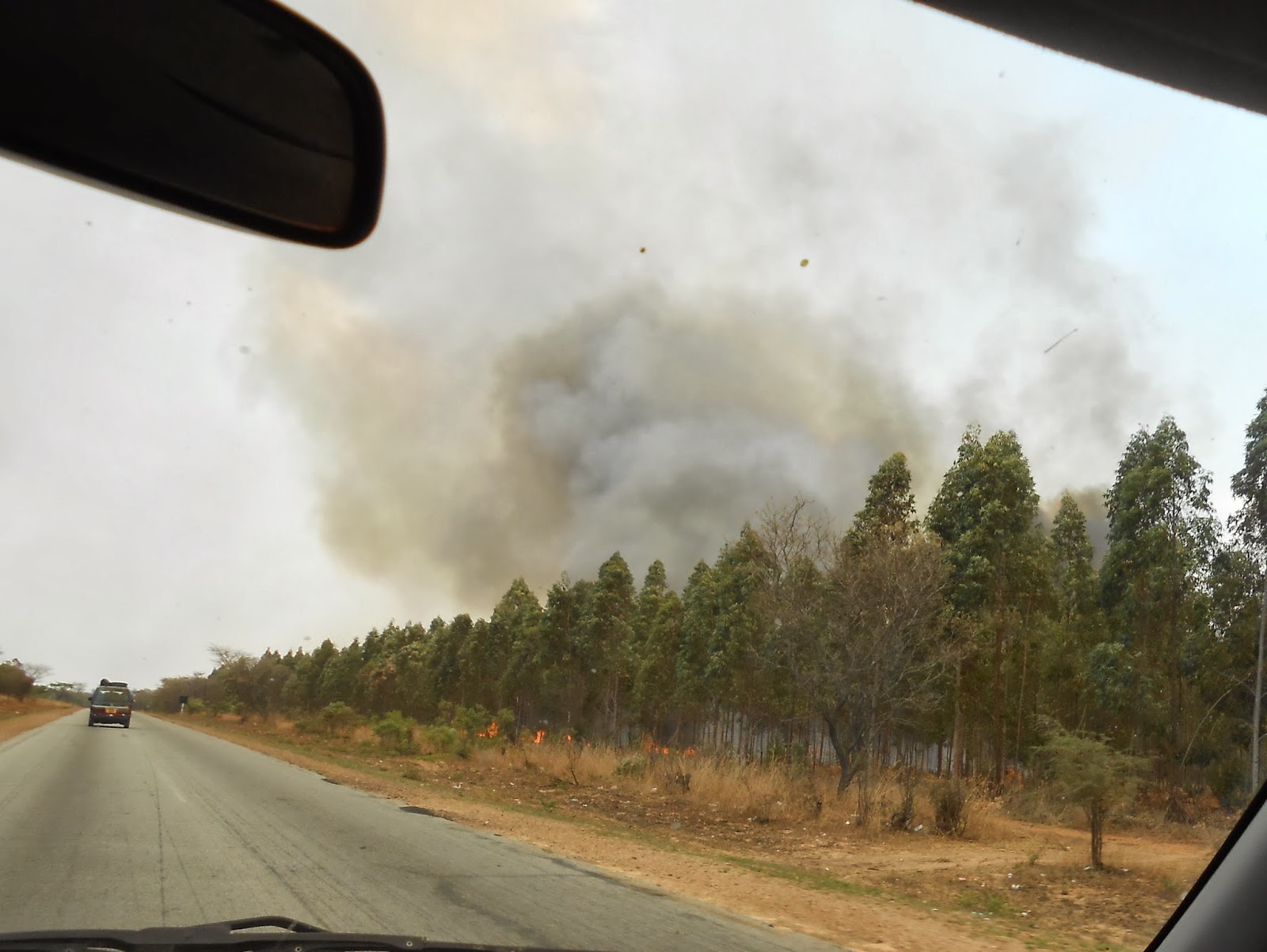
As we are busy settling into Spain after a marvelous, too-short summer in the US, I am none-the-less thinking of Zimbabwe constantly.  Though there's a lot I miss, here is one thing I don't... Late July and August means burning, burning, burning and smoke, smoke, smoke.  As fields get cleared for new crops, the end of winter and early spring means Zim is full of farmers setting fire to the brush that has not received rain in six months.  I don't miss this, Zim!


Wednesday, August 6, 2014

The Popular President

I heard it was Obama's birthday this week.  It reminds me, this guy has no idea how popular he is in Africa.  He is everywhere in Zimbabwe as a symbol of pride, and enthusiasm for democracy.  Most often he can be seen on imported American shirts and US election paraphernalia, but something about the flare on this shirt Jonas and I came across one afternoon tells me the fabric may be authentically from Africa...