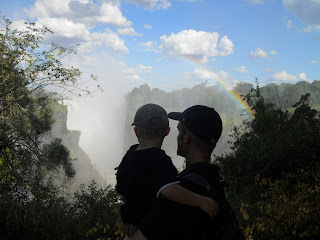
Though it wasn't intended, my recent trip throughout the land of Zim proved to be a lesson all about Mother Nature's relationship with the rawest, most beautiful continent in the world...

If our three year old learned nothing from the rest of our road trip, he certainly learned a ton at Somalisa. That's because he watched three lionesses, eight cubs, and one male lion eat the insides out of a giraffe. Death and life, everywhere; the ultimate lesson.

To back up a bit, we had decided that no visit to Africa could quite be complete without a quality safari. When American Abbie emailed, "Do you think we could actually see some giraffe?!?" before coming to visit, I did not have to think twice or ask any one else. Yes. Absolutely we would see some giraffe.
What I did not know was just how lucky we would be.

What I did not know was just how lucky we would be.
We stayed in Hwange National Park, just a few hours south of Vic Falls, for two unforgettable days and nights in a bush camp a few hours into the park. We could not have asked for better. (Translation: I am about to sicken you with a plethora of animal photos.)
Hwange National Park is a monster. Weighing in at oh, approximately the size of Belgium, this giant combination of woodlands and grasslands makes up the largest game reserve in Zimbabwe. It is teeming with large and small game and over 400 varieties of birds, all sitting atop Kalahari sands that have blown in from Botswana's famous desert for centuries. Here is a tiny portion of our adventures in a magical place called Hwange:




The ever illusive hippo...


Cape buffalo will win any staring contest.

Someone had a bad day.

Wildebeest, well known in these parts for being many pieces of animals sewn together into one strangely ugly one.


Sunrise in Hwange. I'm in love.
Hwange National Park is a monster. Weighing in at oh, approximately the size of Belgium, this giant combination of woodlands and grasslands makes up the largest game reserve in Zimbabwe. It is teeming with large and small game and over 400 varieties of birds, all sitting atop Kalahari sands that have blown in from Botswana's famous desert for centuries. Here is a tiny portion of our adventures in a magical place called Hwange:

Love it. Solar powered pumps located intermittently throughout the grasslands draw water to the surface from boreholes deep in the ground. It looks strange in the wilderness of Africa, but this provision of water saves thousands of wildlife lives every dry winter. One of the most high tech things I've seen in this country. Love it.

Giraffes love using the roads. We followed this giraffe for a few km before he stopped off for a Slurpee at 7-11.

Termite mounds everywhere. Looks small, but this one is probably 12-15 feet tall.
Nature's toilet seat, the waterbuck, who actually rarely hangs out by the water

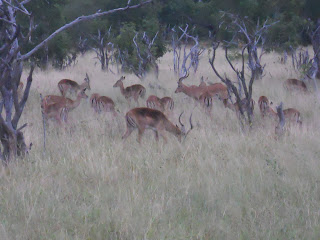
A herd of impala, easy to identify with the male's large horns

Baboon are surprisingly seen on the ground more than in the trees.

Score. We got so lucky to see a kill within twenty yards of our vehicle. What made it incredible was not just that that would keep the lions and vultures in one place for days, but that we were introduced to eight energetic, playful lion cubs.


We woke to the roaring of a lion close-by on our first morning in the camp... an incredible, gutteral, slightly terrifying sound. This hard to find predator was calling to
locate the rest of the pride. A day later he showed up at the kill to
eat his share, pay alimony, and have some visitation hours with his
cubs.

Hundreds of gorgeous vultures waited patiently near the kill, anticipating their turn after the lions.

A shy steenbok peeks out of the bushes
Elephants galore. I have about three hundred pictures of the famous elephants of Hwange alone, so pardon me while I over enthusiastically share one of my favorite animals of the grasslands.

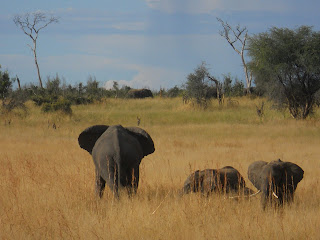
Elephant bones littered the landscape.
The ever illusive hippo...
Cape buffalo will win any staring contest.
Someone had a bad day.

Wildebeest, well known in these parts for being many pieces of animals sewn together into one strangely ugly one.
Some strange looking humans also showed up...


Zebra , cape buffalo, and jackals

My favorite bird -Zazu in the Lion King- the hornbill
Zebra, ostrich, and giraffe


Sunrise in Hwange. I'm in love.