Wednesday, April 17, 2013

Matopos: The Spiritual in Nature


Though it wasn't intended, my recent trip throughout the land of Zim proved to be a lesson all about Mother Nature's relationship with the rawest, most beautiful continent in the world...

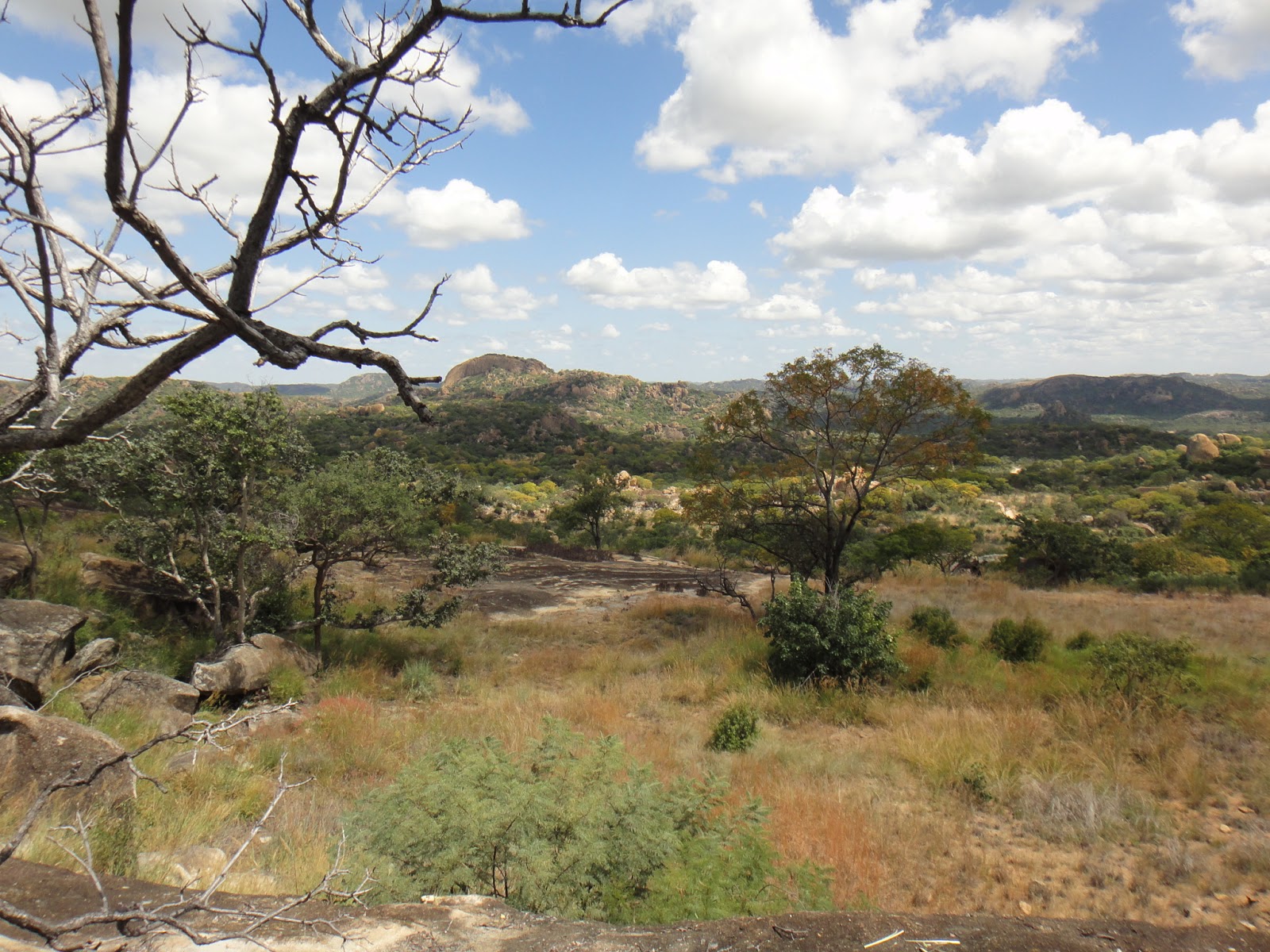
Ahh, my Motopos.  Also called Matobo, this area of granite kopjes and wooded valleys that lies 45 minutes south of the city of Bulawayo is considered by many here to be the spiritual homeland of Zim.  When visiting friend Abbie asked for me to expand on that concept before departing on our roadtrip, I couldn’t really explain.

“But what’s there?” she’d asked.

“Hills…But it’s supposed to be beautiful,” was all I could promise.

Beautiful, indeed.

Though the Ndebele translation of Matobo literally means “bald heads,” Matobo National Park is anything but barren. Designated as a UNESCO World Heritage Site in 2003, the park’s distinctive landforms are a unique treasure to the African landscape. And its land is the definition of beauty.  Views of two billion year old hills scattered with giant boulders and thickets of flora carry out for miles.

My crazy art loving heart appreciates the experience of awe more than just about any other feeling.  It’s that piece of nature-a feeling of awe- that makes me feel most connected to something divine. A quote that has been stuck on me ever since it I heard it during childhood says it well.   “We know that God is a true artist not only because of the beauty He creates for us to see but by the thousands of flowers that sit on hillsides never touched by human eyes.” Awe inspiring nature like that which I constantly found on our latest African road trip reminded me over and over of the beauty of the earth, created as an ultimate form of art.  Motopos stopped me in my tracks for days and left me feeling connected.  

Spiritual homeland, indeed.


The park houses the resting place of Cecil Rhodes (founder of Rhodesia, and a not-too-popular man in these parts), as well as other memorials and tombs. These are located on the top of a hill called "The View of the World." It was a little climb, but oh, what a view!


Inside of the park are also a number of "rock art" (also known as cave painting) sites.  Here visiting Nswatugi, a remote little trek up a stern hill proved to be well worth it.


The park had numerous dams, all made in part by gorgeous beds of boulders.

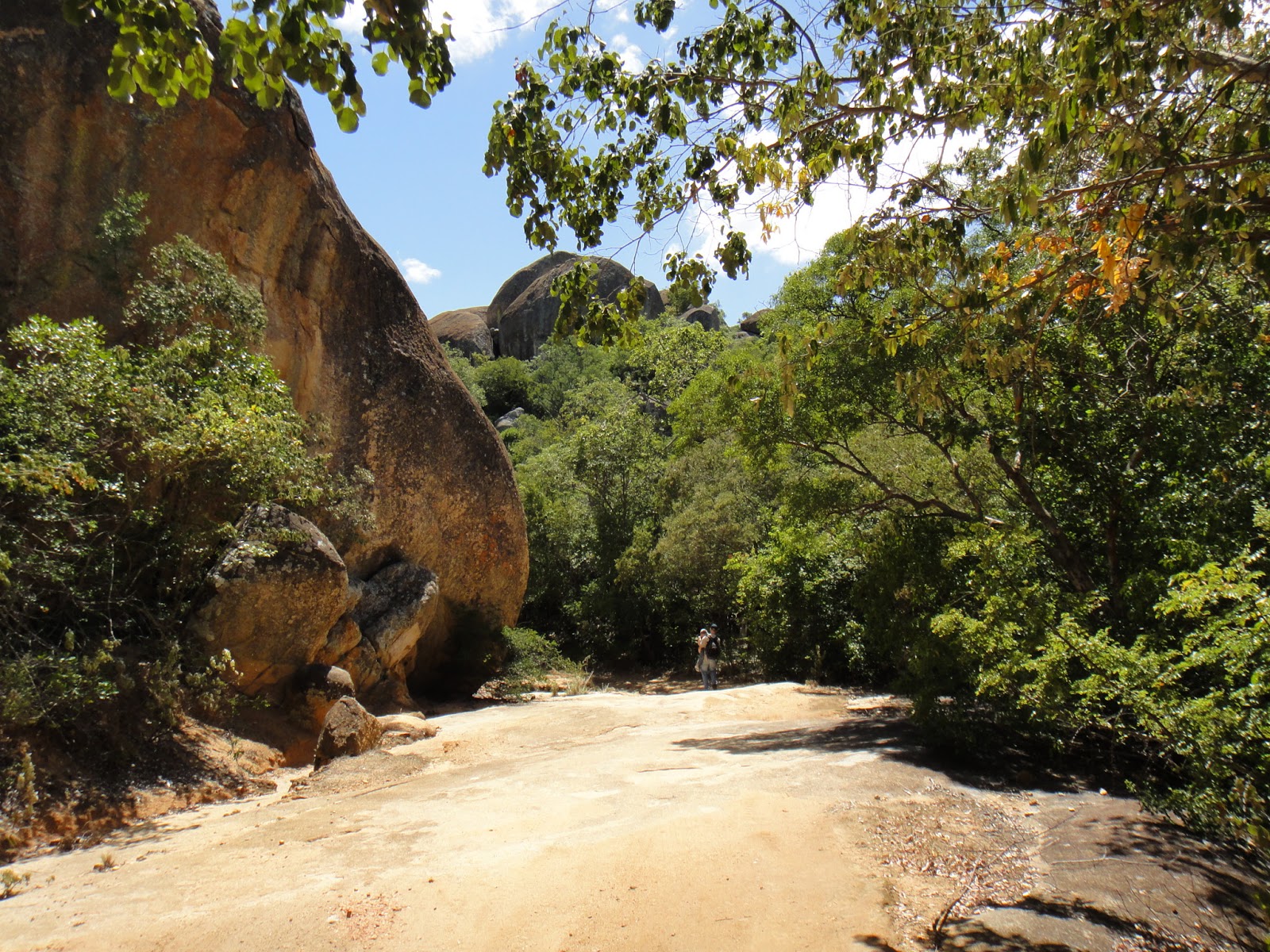

 It's easy to forget how big some of these boulders are... pictured above is Kurt and Jonas next to one for scale.


Some fun wildlife in the park, too, but don't be mistaken for a poacher...


Saturday, April 13, 2013

Great Zimbabwe: Human History Meets Natural History


Though it wasn't intended, our recent trip throughout the land of Zim proved to be a lesson all about nature's relationship with the rawest, most beautiful continent in the world... 


Our first stop, Great Zimbabwe, is a funny place.  As a World Heritage Site just four hours south of Harare, it is one of the Zim places best known by an international audience.  But if you ask a large number of locals, almost all will say they have never taken the detour to see this massive city of ruins that ruled their land for centuries.  As we explored the ruins with our guide Alios and his unfinished walking stick by our sides, we stood amidst stones carved by thousand year old hands and felt very small. 


Though it wasn't intended, our recent trip throughout the land of Zim proved to be a lesson all about nature's relationship with the rawest, most beautiful continent in the world... Everywhere we went, starting on that first day in Masvingo, we found ourselves struggling with the awe of our tiny lives amid such a monumental setting that had seen millions go before us. 

Growing up in Iowa my concept of history as a child spanned approximately 150 years.  My surroundings were mostly new, and certainly felt less than historical. When I moved to London and New York City, my sense of history and my physical placement among significant locations grew to -gasp- almost five or six hundred years.  I found myself eating lunch among colonial gravesites that had watched as the cities grew around them. And it blew me away. And changed where I stood in creation.

Then came Africa.

History here seems not measured in just years or centuries, but feels somehow connected to the very first days of the earth. Primal and primitive, my Africa stands touched and untouched as a reminder of the earth that exists as a witness of a fleeting human race.  The hills and mountains that look over Great Zimbabwe's empty shoulders are a powerful reminder of ancient times that have come and gone over and over.  

Below is a quick introduction to a haunting World Heritage site that readied me for the many days of ancient Africa that soon followed:

Great Zimbabwe's most prominent feature, its mortarless walls, were constructed mostly of carved soapstone starting in the 11 century, and served as a royal palace for the monarch of the Kingdom of Zimbabwe for hundreds of years. Unique artifacts and sculptures have been found throughout the ruins.  Many of these have been recently returned to Great Zimbabwe's living room sized museum from foreign countries that removed and preserved these pieces in their own museums worldwide. The ruins are categorized into three parts: the Hill Complex, Valley Complex, and the Great Enclosure. 

Great Zimbabwe's Great Enclosure is the most famous structure; at 36 feet high (11 m) it extends approximately 820 feet (250 m).  It stands as the largest ancient structure south of the Sahara Desert. Here Jonas, friend Abbie, and Alios stand in the middle of the queen's quarters.

The ruins together span 1,800 surrounding acres and at one time housed over 18,000 inhabitants. 

The walls feel both oddly empty and full of life at the same time; hundreds of vervet monkeys now call this city of ruins home.  Jonas was tickled.

Alios and Kurt, with Jonas running ahead

The chevron design (along the top of the wall) is a pattern that originates here but is mimicked all over the country.

The crazy flora surrounding the ruins made me feel like I was in Peter Jackson's King Kong.

A sample Shona village below the ruins preserves some of the ancient culture.  (I love that this dancer has a cell phone in her hand.)

 Jonas' reaction to the dancing.

Tuesday, April 9, 2013

The Road

Day one of our recent road trip through Zim was all about practicing our Dukes of Hazard moves.  In a situation we still cannot figure out how exactly we found ourselves in, we took a three hour detour when our- apparently incorrect- tarred road suddenly became an occasional combination of sand, gullies, large rocks, washed out dirt, and cattle. I’d always scoffed at American trucks that had ridiculously large monster truck wheels, but scoff no more.  Now I know.  They were all on their way to Africa.

If you ever experience a wrong turn, the result looks a lot like the process of grieving. 

1. First there’s denial and isolation: “No, this has to be the right road. The pavement should come back any second.There's no way we are as far from civilization as we look...”
2. Then anger: “How is this possible?!  Nothing is on this godforsaken map from 1920!”
3. Then bargaining: “Please, God. If we make it out of here alive, I’ll quit making sarcastic comments on my blog. I promise.”
4. Finally depression sets in: "We'll never get out of here.  I'm gonna die in a ditch with my road map..."
5. Then acceptance: "Okay; we're lost.  Follow the first vehicle or livestock you see."

Desperation should probably be somewhere in there, too, as we actually pulled over and tried to get directions from this little guy, who spoke no English, and had most probably never been more than 15 miles from his home.


Never should I ever have considered myself lost before.  When you are in the middle of Africa for hours on a non-road, with no concept of where you would be on a map or where you are going, and no ability to turn around, that is the true definition of lost. Thank God for four wheel drive, pieces of the Shona language, a patient child, and the ever friendly Shona and Ndebele we have met every place we’ve gone.  This lovely pick-up full of gracious men finally led us to a paved road... here they are, picture taken about one second before a near catastrophe with an oxen-pulled cart.


Though the roads throughout the country vary greatly from city to city and field to field, here are some generalized tidbits we picked up during our almost forty hours of cross-country driving:

1. We went through 39 police stops before arriving safely back in our driveway.  Police here almost never have cars, but instead stand in the road to stop oncoming vehicles. There are many things police look for.  Too many to mention.  But for example, cars cannot have a radio in the car without a special radio license posted on the front window.

2. Many roads look like this:

 
 One lane of pavement shared by two lanes of traffic. A dangerously efficient way to provide roads.

3. Tolls are $1.00.

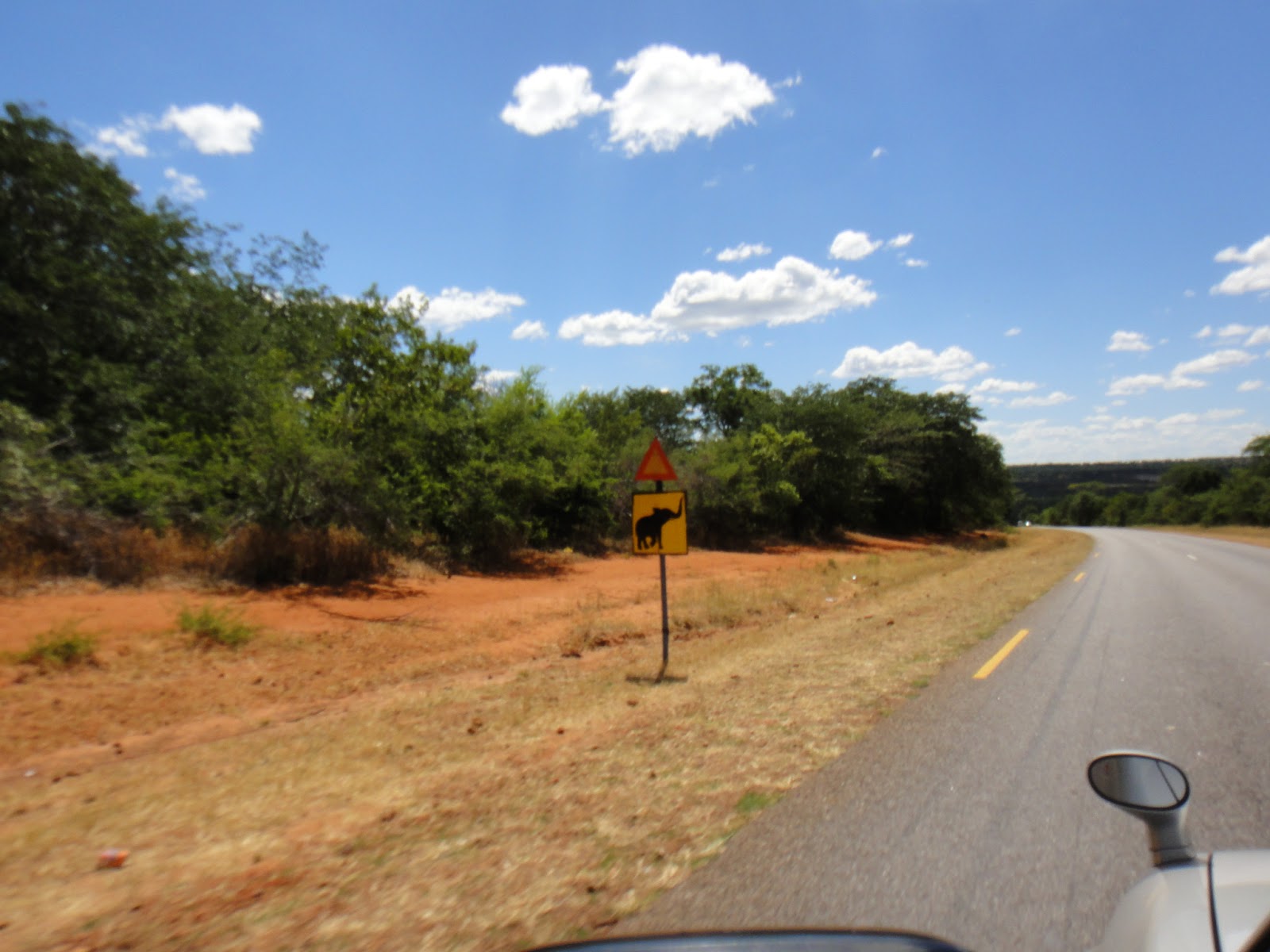
4. Though speed limit signs are less than common, crazy crossing signs are standard.

 antelope
 elephant
 painted dog

5. Hitchhiking is insanely common.  It is many people's only mode of transportation.


6. Occasionally roads will just turn into large slabs of rock.  Keep driving.


7. It's not just a cliche.  Livestock really does spend a lot of time on the road.


I have about 8,000 of these pictures.  

8. Roads are dangerous, and not often traveled at night. 


9. Africa is beautiful.  Wherever you are.


Highly recommended: the road less traveled.

Sunday, April 7, 2013

At Your Local Grocery Store, Two

While I organize our trip photos, here are a few more examples of our local products:

Can't find thousand island dressing here... but A Thousand Island is everywhere!

Our chip availability here...


Monday, April 1, 2013

March Flowers

So here I am, visiting the world's most amazing waterfall, Victoria Falls, and all I can think about is getting online... We are on an A-MAZING roadtrip, currently 18 hours from home and loving every minute of it... even with the worst technological frustrations possible.  The internet- the first we've had in five days- somehow disconnects every 3 minutes.  Ho hum... You will just have to read this previously written and uploaded blog in the meantime, not at all related to our travels, but rather to the yard we recently left behind.  Enjoy your Easter celebrations, and hopefully my next post will continue to prove how safe and sound we are on our fantastic road trip...


How did that month go so fast?  Just posted Feb flowers, and now it's time for March! For those of you botanical lovers out there, here are pictures of the flowers surrounding us here in March.  Meet the "fall" collection...